Jay Sen Lon
September 25, 2026


You already know a full UAE tax invoice needs the TRN, the tax breakdown, and the right words displayed, and you know one missing field can block a client's input VAT recovery. Catching that by eye on hundreds of invoices a month isn't a system, it's luck. Here's how to set up a workflow that validates every invoice against those rules automatically, codes it to the right chart of accounts entry, and posts it before anyone has to dig through a shared drive later.
TLDR:
Automated UAE VAT invoice processing means using software, AI based or rules based, to capture, read, and code supplier and customer invoices so the VAT relevant fields make it into your accounting records without anyone typing them in by hand.
The core mechanics break into 5 steps:
This is worth separating from e-invoicing, the UAE's coming government mandated exchange format for how invoices move between businesses. Automated processing covers what happens internally once an invoice lands on your desk, regardless of whether it arrived as a scanned PDF or a structured e-invoice file. You can automate your internal processing today, independent of when e-invoicing becomes mandatory for your clients.
Before automating anything, you need to know what a compliant invoice looks like. The Federal Tax Authority requires every full tax invoice to carry specific fields, and a missing one can block your customer's input VAT recovery entirely.
A valid full tax invoice needs:
The FTA also allows a simplified tax invoice for supplies under a certain value, dropping some customer detail but still needing the supplier TRN and tax breakdown. Your automation tool needs to recognize which format it sees and validate accordingly, since a missing field that's fine on a simplified invoice fails a full one. Extraction alone won't catch that gap; validation will.
The UAE's Electronic Invoicing System, introduced under Ministerial Decisions 243 and 244 of 2025, rolls out in phases. Voluntary participation opens July 1, 2026. Mandatory adoption follows by revenue: businesses over AED 50 million from January 1, 2027, smaller businesses from July 1, 2027, and government entities from October 1, 2027. The system uses a 5-corner Peppol exchange: ASPs transmit structured XML between supplier and buyer while reporting the transaction to the FTA. Full detail sits in the FTA's UAE e-invoicing framework.
| Date | Who it applies to |
|---|---|
| July 1, 2026 | Voluntary participation opens for all businesses |
| January 1, 2027 | Mandatory for businesses with revenue over AED 50 million |
| July 1, 2027 | Mandatory for smaller businesses |
| October 1, 2027 | Mandatory for government entities |
That XML still needs validating, coding to your chart of accounts, and posting to your accounting software. ASPs move data between businesses; they do not touch your ledger. You still need a processing layer, one that also covers receipts, foreign invoices, and anything below the revenue threshold still arriving the old way.
Manual VAT invoice entry fails in predictable ways: a mistyped supplier TRN gets flagged on review, a transposed tax amount breaks the ledger reconciliation, or a duplicate like INV-1042 and INV1042 slips through and gets paid twice.
Industry data puts manual invoice processing error rates near 2%, driven by keying mistakes and missing validation at entry. Automated invoice data capture checks against expected formats and duplicates drop that below 0.8%, per research from Ascend Software. Across thousands of invoices a month, that gap becomes a stack of corrections caught only when the FTA asks a question you cannot answer cleanly.
Automated VAT invoice processing runs in a fixed sequence, and each stage catches something the previous one cannot.
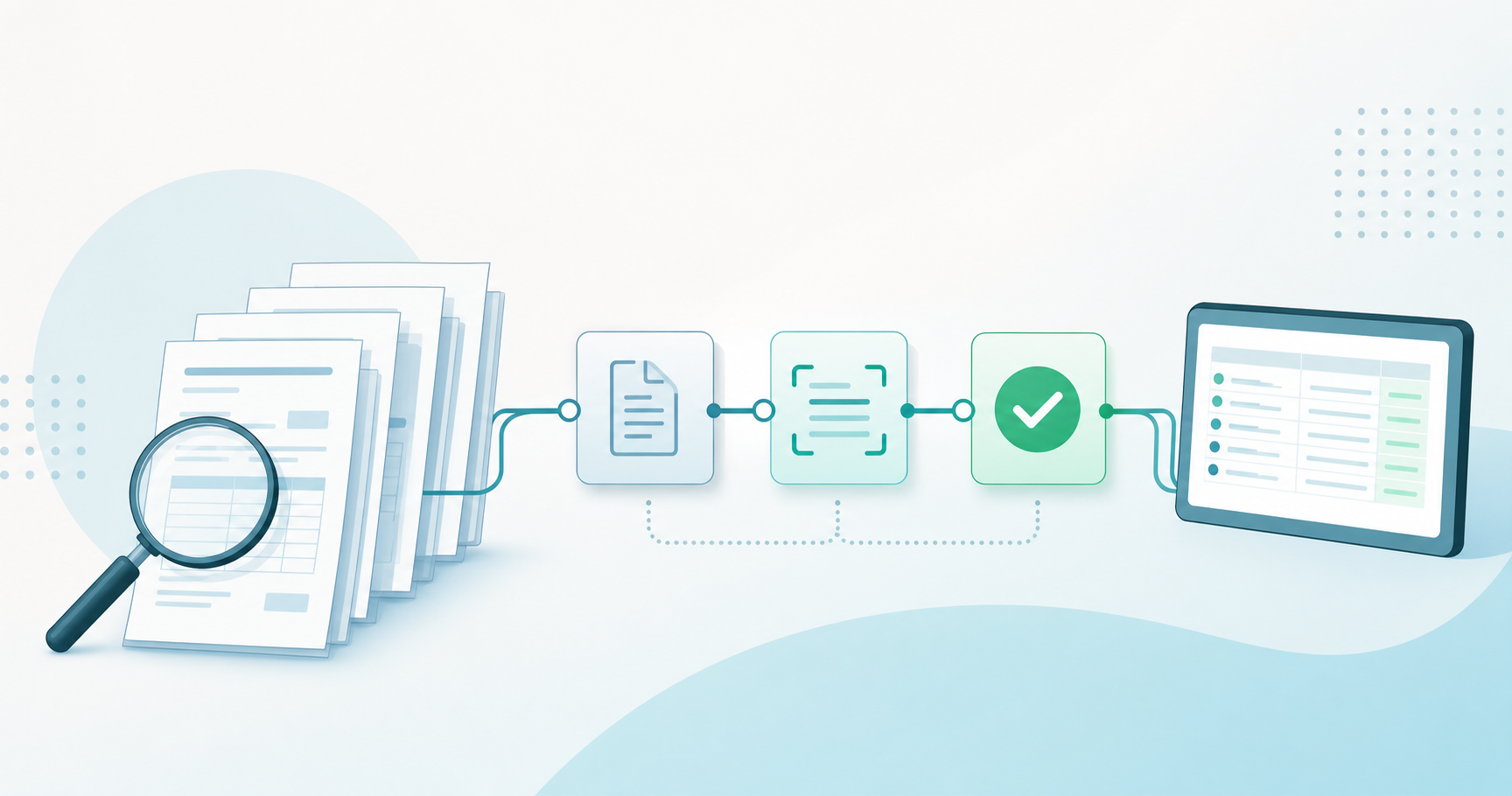
Line-item extraction depth separates real automation from header capture: a tool reading only the total cannot tell you which lines were zero rated.
Confirm the tool validates against FTA mandatory fields automatically, catching a missing TRN before the invoice reaches your ledger, not after a client questions an input VAT claim. Confirm it also validates the tax breakdown by rate. Check that it recognizes both full and simplified tax invoice formats, since the mandatory fields differ between them. Ask whether it reads Arabic and English fields on the same document without manual translation, since most UAE suppliers mix scripts on one invoice. Look for direct posting into your accounting software, Zoho Books, Xero, or QuickBooks Online, with the source document attached, instead of a CSV export you still have to re-key. Finally, confirm duplicate detection runs before posting, checking supplier, date, and amount together, since a mistyped invoice number is exactly the gap that lets a duplicate payment through.
UAE suppliers often issue invoices with Arabic and English on the same page, sometimes splitting the tax label and line item description across both. Right-to-left Arabic and left-to-right English fields mean a processing tool must identify the total and the supplier's location regardless of script direction.
This is a data structure problem, not character recognition. Knowing that ضريبة القيمة المضافة means VAT still requires mapping that field to the correct chart of accounts entry, in a format your reviewer can check without reading Arabic.
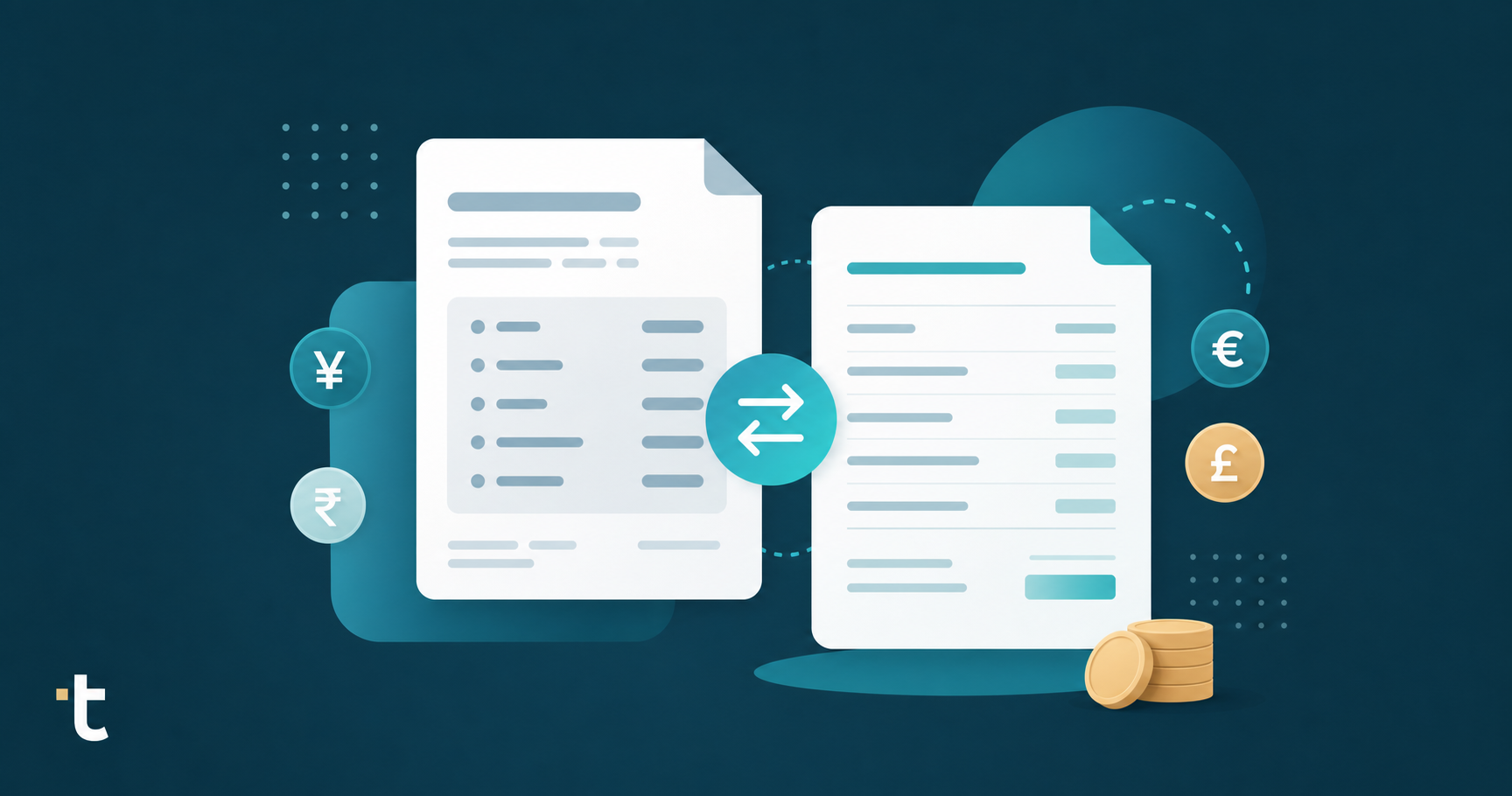
Multi-currency invoice processing adds another layer: foreign invoices need correct AED VAT treatment under import VAT or reverse charge rules. Choosing the right multi-currency invoicing software and coding currency, amount, and tax treatment correctly before the ledger stage keeps downstream accounting reliable.
Rolling out invoice automation rarely goes as smoothly as the pitch deck suggests. Suppliers send invoices in different formats, some clean PDFs, some photographed paper, some handwritten delivery notes, and a tool trained mostly on standard layouts stumbles on the rest. Firms comparing invoice capture software also hit integration gaps when accounting software has no native connection, forcing CSV workarounds. Staff resistance is real too, since bookkeepers who built years of muscle memory around manual entry don't hand that off easily.
The common hesitation is "can I trust this fully?" Manual entry has no audit trail and the errors are invisible until review. The fair comparison is automation against what you're doing now, not against perfection.
UAE VAT records require 5-year retention after the relevant tax period, as set out in UAE document retention guidance from Crown Records Management; corporate tax records now require 7 years under Article 56 of Federal Decree-Law No. 47 of 2022. Firms using multilingual accounting software can align record-keeping across Arabic and English documents from the start. Capital assets and certain real estate records run longer, but the standard invoice window is what most firms plan around.
Audit readiness means the FTA can trace a ledger entry back to the original invoice without a bookkeeper digging through a shared drive. That link has to stay legible and accessible for the full five years, and not merely present at filing time.
Paper trails fail quietly here: thermal receipts fade, PDFs on personal laptops get lost to staff turnover, and manual filing depends on someone remembering where a document lives years later. Automated processing attaches the source document to the transaction at posting, so the link never depended on anyone's filing habit.
Invoice processing is one link in a longer chain. The same firm handling VAT invoices also needs bank statements matched, credit card statements coded line by line, and everything rolled up for VAT return preparation in EmaraTax. Selecting the right AI AP automation software helps avoid the trap where automating invoices while bank statements still get keyed by hand just moves the bottleneck downstream.
Stopping at a spreadsheet or CSV export undoes most of the benefit: a tool that extracts an invoice but hands you a file to re-key into Xero, QuickBooks Online, or Zoho Books reintroduces the transposition and duplicate risk automation was meant to remove.
Direct posting closes that gap. Extracted, coded data lands straight in the ledger with the source document attached, so invoices, bank statements, and credit card statements feed the same chart of accounts through the same review step.
Tofu, an AI document processing platform, reads every line item on a UAE VAT invoice, beyond the total, and splits standard rated, zero rated, and exempt lines automatically instead of flattening mixed invoices into one blended rate.
"I like the line item thing and I like it that they automatically save the attachment in QuickBooks because it makes auditing procedures much quicker."
South African accounting firm director
Zoho Books holds roughly 75% market share among UAE accounting firms, so Tofu's Zoho Books integration includes Reverse Charge Mechanism field support, annotating RCM correctly across AP bills, AR invoices, and direct expenses, a treatment easy to miss on manual entry.
Tofu reads Arabic and English fields on the same invoice, extracting supplier TRN, tax breakdown, and line items regardless of script, without manual translation.
Tofu does not file VAT returns or balance ledgers. It publishes coded invoice data to Zoho Books, Xero, or QuickBooks Online before those tasks begin.
Your invoices will keep arriving in mixed formats, Arabic and English, single currency and foreign, for a while yet. Building a solid validation and coding step now means you are not scrambling when e-invoicing volume ramps up. Feel free to book time with Tofu to walk through your own invoice mix.
A valid full tax invoice needs the words "Tax Invoice" displayed clearly, the supplier's 15-digit TRN, customer TRN where applicable, invoice date, supply date if different, line-item descriptions, and tax broken out by rate (standard 5%, zero-rated, or exempt). Your automation tool needs to validate all of these fields at extraction, not after the invoice reaches your ledger. A missing TRN or absent tax breakdown blocks your customer's input VAT recovery entirely.
Yes. The UAE's phased e-invoicing mandate opens for voluntary participation July 1, 2026, with mandatory adoption following by revenue tier through 2027. Internal processing automation, which covers extracting, validating, coding, and posting invoices, works independently of that mandate and handles the documents arriving now: scanned PDFs, photographed paper, and foreign invoices that fall below the revenue threshold or arrive outside the structured XML exchange.
Tofu reads Arabic and English fields on the same document without manual translation, extracting supplier TRN, tax breakdown, and line items regardless of script direction. HubDoc captures header-level data only, so the tax breakdown and line items still require manual entry. Dext charges extra credits for non-standard processing and requires substantial correction on non-Latin character fields. For UAE invoices where the tax label and line-item descriptions split across both scripts, the distinction is whether your tool understands what a field means in context, not merely what characters it contains.
Extract at line-item level, not header level. A tool reading only the invoice total cannot tell you which lines carried standard 5% VAT and which were zero-rated or exempt, so every mixed-rate invoice still requires manual re-checking. Tofu splits standard-rated, zero-rated, and exempt lines automatically during extraction and codes each to the correct chart of accounts entry before posting to Zoho Books, Xero, or QuickBooks Online.
UAE VAT law requires businesses to retain records for 5 years after the relevant tax period, with capital assets and certain real estate running longer. Automated processing keeps that audit trail intact by attaching the original source document to the transaction record at the point of posting, so the FTA can trace any ledger entry back to the original invoice without a bookkeeper digging through a shared drive years later.