Jay Sen Lon
September 6, 2026


Your firm processes invoices, receipts, and statements every day. At some point you have to decide which capture tool pays for itself.
Dext and AutoEntry answer that question differently. One bills per client, the other per credit, and both charge extra the moment you need every line item pulled out. Here are the real cost differences, where each tool falls short, and how to tell which one matches the way your firm works.
TLDR:
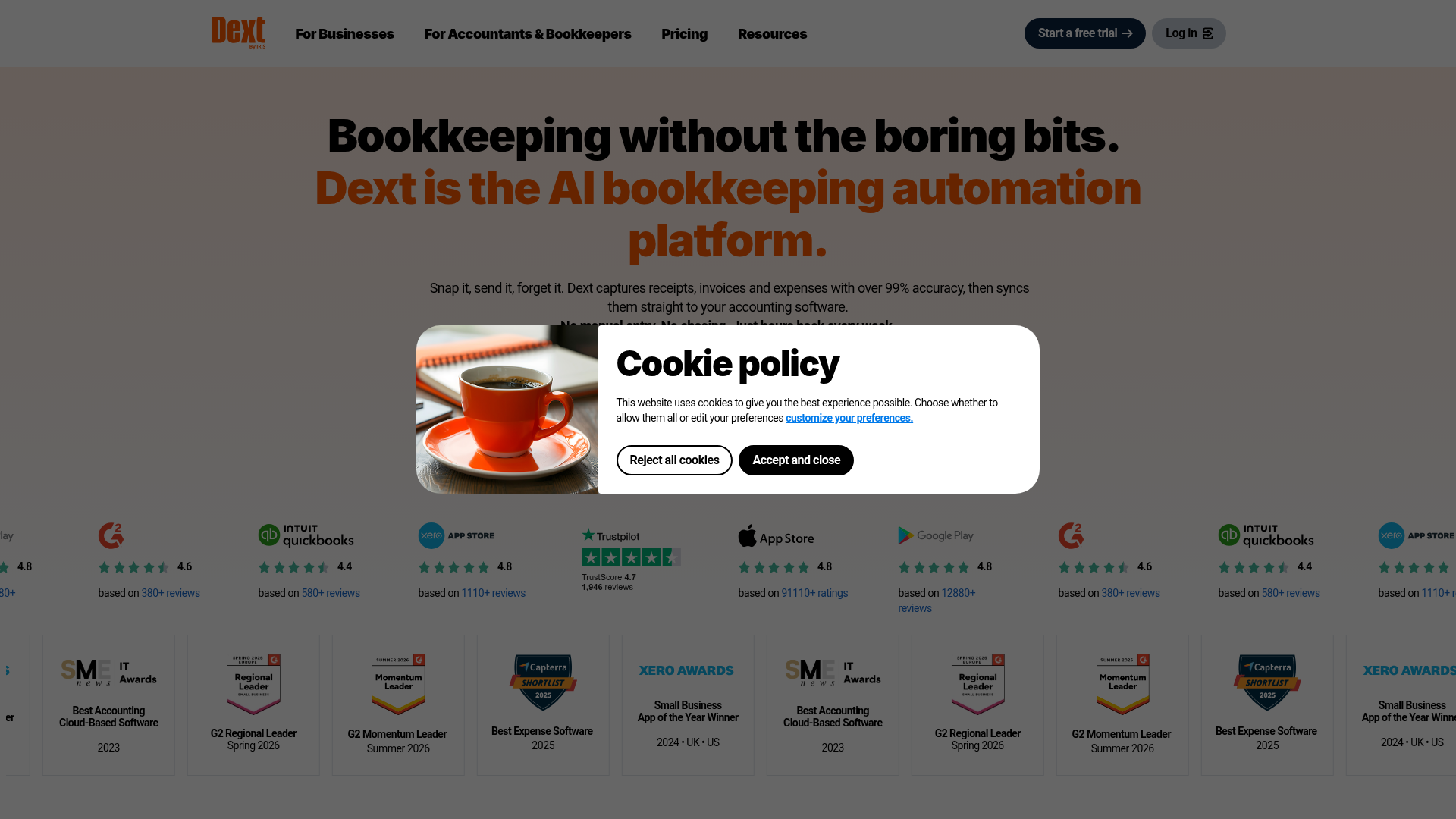
Dext is a document capture platform that pulls data from receipts, invoices, and bank statements and publishes it to Xero, QuickBooks, Sage, and more than 30 other accounting platforms. Documents come in through the mobile app, email forwarding, or direct upload, and Supplier Rules route recurring documents to the right account codes once you have set them up.
Pricing has two ladders. The Business plan is $25.21 a month billed annually, or about $31.50 month to month, for five users and 250 documents. Practice plans come in two tiers, Essentials and Advanced, priced per client per month with a 10-client minimum. Out of the box, Dext captures the total and header fields. Pulling out every line item is a paid add-on, not part of the base price. Firms comparing Dext alternatives usually start from that add-on bill.
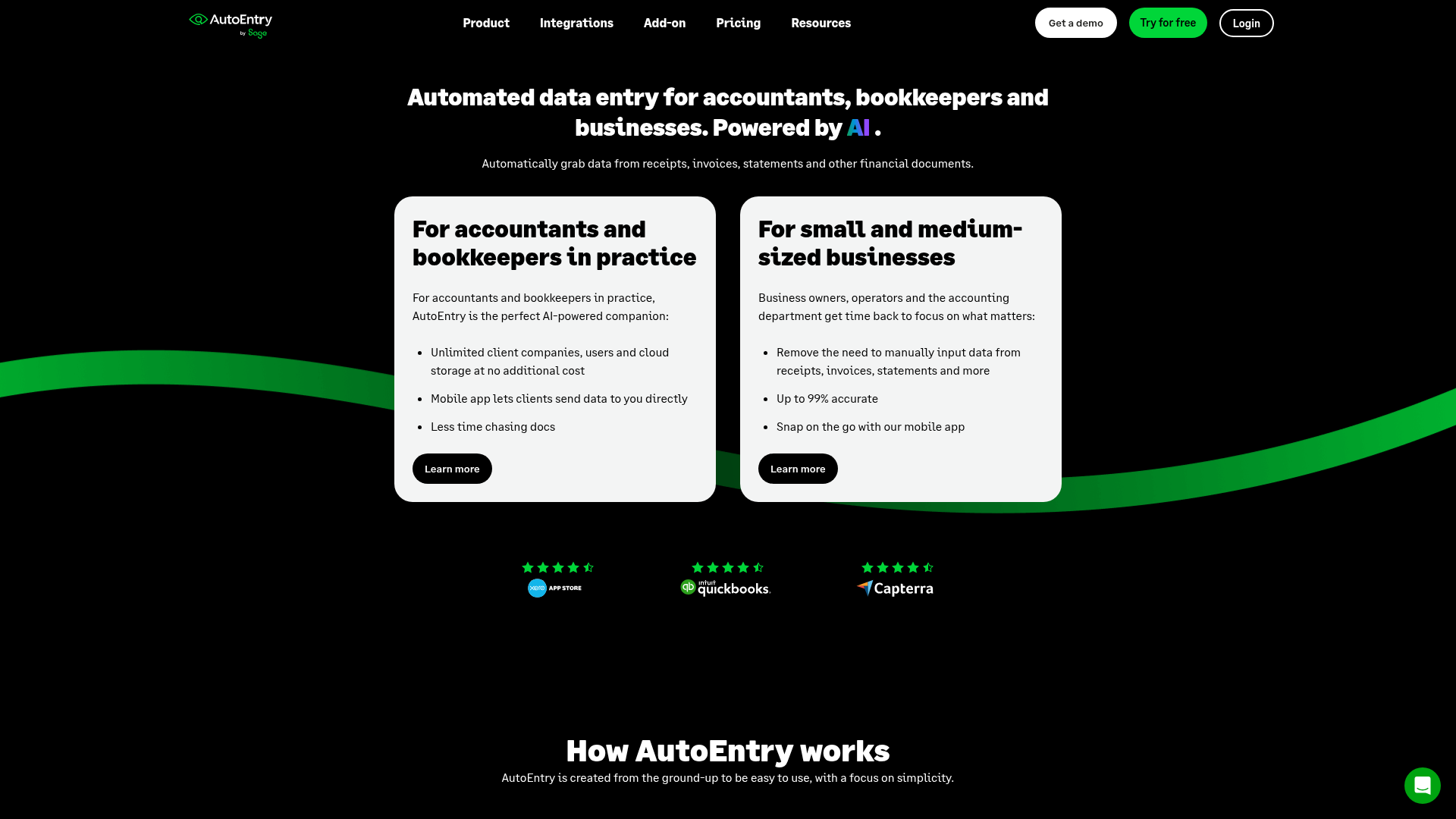
AutoEntry is a document capture tool owned by Sage. It pulls data from invoices, receipts, and bank statements and pushes it into Sage, Xero, QuickBooks, or FreeAgent. Its footprint is strongest with UK and Ireland practices, where Sage is.
Instead of a flat fee, AutoEntry runs on credits. You buy a monthly bundle, from Bronze at $14 for 50 credits up to Sapphire at $469 for 2,500, and each document type draws down a different amount:
Unused credits roll over for 90 days and then expire. Overages bill at up to 200% of the standard credit rate. If you are weighing other options, the roundup of AutoEntry alternatives in the UK covers the field.
Both tools treat line-item extraction as an upgrade rather than something baked into the base price. That matters more than the headline plan cost, because the number on the pricing page rarely reflects what you pay once documents need line-level detail.
Dext stacks add-ons on the base plan. Third-party listings put bank statement extraction from about $13 a month, line-item extraction from about $20.50, and AI Assist at $10.50 on the Business plan; Dext's own pricing page shows the structure without the figures. AutoEntry charges per document instead: an invoice with line items costs double a plain one, and bank statements bill per page rather than per document.
| Dext | AutoEntry | tofu | |
|---|---|---|---|
| Base plan | Business: $25.21/month annual for 5 users and 250 documents. Practice: per client per month | Credit bundles, $14 for 50 to $469 for 2,500 | Flat $79 or $199/month, unlimited users |
| Line-item extraction | Paid add-on, from about $20.50/month | 2 credits per invoice (1 without) | Included by default |
| Bank statements | Metered beyond an included allowance, add-on from about $13/month | 3 credits per page | Any length, no per-page charge |
| Minimum commitment | 10 clients on Practice plans | No stated minimum | None |
| Languages | English and major European | English; Arabic, Chinese, Japanese unsupported | 200+, including handwriting |
The practical effect is the same either way: extracting every line item costs more than extracting a total, whether through Dext's pricing structure or AutoEntry's credit-based system.
AutoEntry's surprise is document mix. A firm on Bronze has 50 credits. Seventeen invoices with line items use 34 of them. One six-page bank statement uses 18 more. That firm is over its allowance with half the month left and every further document billing at overage rates. Two firms on the same tier can land on very different annual totals depending on what their clients send.
Dext's surprise is growth. Practice plans are priced per client, so the bill moves every time you onboard someone, even if documents per client stay flat. Add the line-item and bank statement add-ons on top and the bill grows on two axes at once: client count and feature depth. The full tofu vs Dext comparison walks through what that looks like over a year.
Dext's Practice plans price per client, so cost scales with how many clients you serve instead of a flat firm-wide fee. Three paid plans, geared toward accounting and bookkeeping firms, range from $234.99 to $848.99 a month billed annually, per Dext pricing details. If you're weighing the cost, you may also want to review the best Dext alternatives for 2026. Each plan includes unlimited users, so the real difference between tiers is client capacity: the lowest plan covers up to 10 clients, the top tier reaches 50.
That structure means growth changes your bill automatically. Add a handful of clients and you may need to jump plan tiers entirely, even if document volume per client stays flat.
Line item extraction and bank statement add-ons stack on top of the base plan, so a firm near its client ceiling running both add-ons pays base rate plus per-month extras. If you're looking to move away from this model, you can review Dext alternatives for accounting firms. The bill grows on two axes at once: client count and feature depth.
Both tools were built with a market in mind, and their language handling shows it.
AutoEntry's document guidelines list Arabic, Chinese, and Japanese as unsupported. Documents in those scripts fail to process rather than extract with errors. For a practice whose suppliers all invoice in English, this never surfaces. For a firm with international suppliers, it is a hard wall.
Dext reaches a little further, into the major European languages, but it does not position multilingual extraction as a capability and does not advertise non-Latin script support. Documents outside its range need substantial correction before the data is usable.
So a firm with clients invoicing in Mandarin, Arabic, Thai, or Japanese needs a separate workflow for those documents. Neither Dext nor AutoEntry closes that gap on its own.
Both tools ask for setup before extraction gets reliable, and the work happens per supplier, not once for the whole firm.
Dext leans on Supplier Rules to map recurring suppliers to account codes, plus Smart Split to break mixed documents apart. Building the rules takes time up front, and the accuracy payoff arrives only once a supplier has enough configured to stop defaulting to manual review.
AutoEntry works the same way at the line-item level. Line-item capture is switched on per supplier, so a new supplier defaults to header-only extraction until someone flips the setting, and each of those invoices then costs the second credit.
Neither tool reads a firm's existing chart of accounts or coding history to configure itself. A new client means new rules, new toggles, and new manual setup before either tool matches how the firm already codes.
Dext and AutoEntry both treat line items as an upgrade and non-English documents as an edge case. tofu, an AI bookkeeping automation platform for accounting firms, starts from a different default. Every line item on every document gets extracted on every plan, and 200+ languages, including handwriting and non-Latin scripts, come included. There is no credit bundle to ration and no per-client fee that moves when you onboard your eleventh client.
Setup is different too. Instead of building Supplier Rules or flipping per-supplier toggles, you connect your accounting software or upload a historical ledger and tofu reads the existing coding patterns, then starts extracting within minutes. "What used to take me 3-4 hours can be done in 30-60 minutes," says Tammy Tan at Klozer.
tofu is not a replacement for Xero, QuickBooks, or Zoho Books. It is the document processing layer that sits before them, extracting, coding, and publishing so the accounting software does what it already does well. Pricing is flat: $79 a month for Pro or $199 for Business, both with unlimited users.
Neither tool hides its pricing structure, but both make you do the math before you know your true monthly cost. Your document mix, client count, and language needs decide which fits better, or whether you need something else. Count what your firm processed last month before committing to either. And if the answer includes line-heavy or foreign-language documents, book a tofu demo and bring the real files.
Neither is a strong fit. Dext is built around English and Latin-script capture with some reach into major European languages, and AutoEntry's guidelines list Arabic, Chinese, and Japanese as unsupported. Firms with clients invoicing in Mandarin, Thai, or other non-Latin scripts need a separate workflow whichever tool they pick.
Dext charges an add-on, listed by third parties from about $20.50 a month, on top of its base plan. AutoEntry charges 2 credits per invoice with line items against 1 for a plain invoice. Both treat line-level detail as an upgrade, so the pricing page number rarely reflects what you pay once documents need it.
Because credits are spent by document type, not document count. Line-item invoices cost double and bank statements bill per page, so a month heavy on either can exhaust an allowance early and push the rest of the volume into overage rates of up to 200%. Unused credits roll over for 90 days and then expire.
Yes. Dext needs Supplier Rules configured per supplier before extraction gets reliable, and AutoEntry needs line-item capture switched on per supplier or it defaults to the invoice total. Neither reads your existing chart of accounts or coding history, so every new client means new manual setup.
When your firm processes multilingual invoices, handles suppliers with 20+ line items regularly, or wants to stop rationing credits and watching per-client fees. tofu extracts every line item in 200+ languages by default on every plan, learns your coding from your existing ledger, and charges a flat $79 or $199 a month with unlimited users.