Jay Sen Lon
June 22, 2026

When your client base includes suppliers in Bangkok, Dubai, and Taipei, you need a document processing tool that doesn't quietly give up the moment an invoice arrives in a non-Latin script. Dext handles the basics well enough for firms operating in one language, but multilingual invoice processing is where the architecture shows its limits: character recognition falters outside familiar alphabets, line-item extraction costs extra credits, and tax code mapping for bilingual jurisdictions requires manual correction more often than not. You're paying for automation that stops working exactly when you need it most. The Dext alternatives for multilingual invoice processing below were built to handle the scenario Dext treats as edge case: invoices in 200+ languages, full line-item extraction without per-document fees, and account code mapping that learns your chart of accounts regardless of what script the supplier printed the document in.
TLDR:
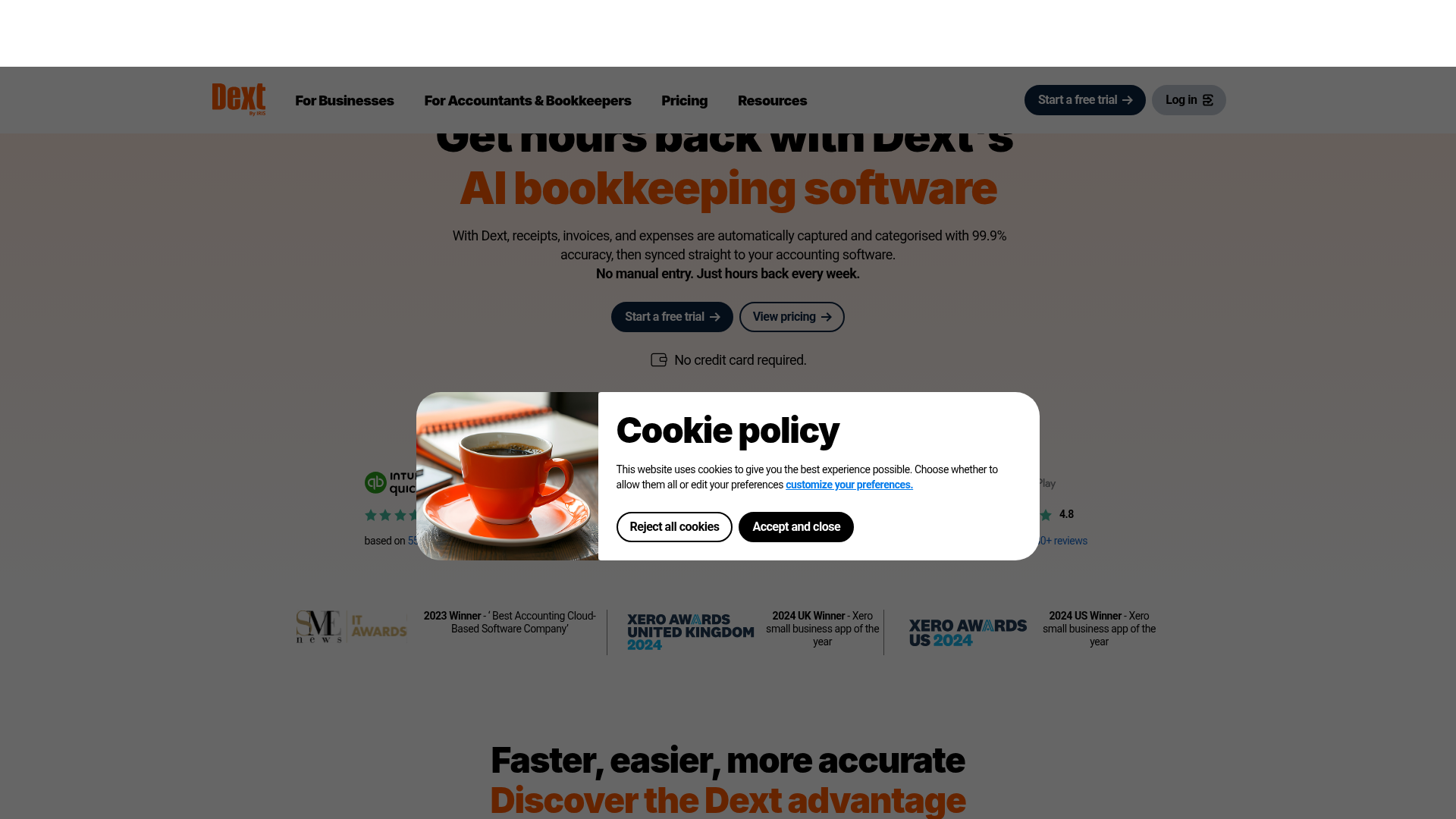
Dext is a document capture and data extraction tool built primarily for accountants and bookkeepers in the UK, Australia, and North America. You photograph or upload a supplier invoice, receipt, or bank statement, and Dext extracts the header-level data (supplier name, date, total amount, and tax) then pushes it to your accounting software.
The extraction engine relies on OCR combined with rules-based processing. For clean, single-language documents from familiar suppliers, it works reasonably well. For anything outside that range (invoices in Arabic, Chinese, or Thai, documents with dense line-item tables, or suppliers Dext hasn't seen before) extraction accuracy drops and substantial correction is required before the data is usable.
Dext was not built with multilingual document processing as a core requirement. A few specific constraints come up repeatedly for firms working across languages:
For firms operating in one language with familiar supplier bases, Dext handles the basics. For firms processing invoices across multiple languages or scripts, the gaps stack up quickly. Accounting firms pursuing bookkeeping automation need tools that work across their entire client base, including the subset using non-Latin alphabets.
Dext handles the basics well enough for firms processing invoices in a single language. The cracks appear when your client base grows across borders.
Multilingual invoice processing is where most document processing tools quietly fall short. Dext's OCR layer was built primarily for Latin-script documents. Feed it an invoice in Arabic, Thai, or Traditional Chinese and extraction accuracy drops considerably for non-Latin scripts. You end up correcting fields manually, re-entering line items, and questioning whether the automation is saving you any time at all.
There are a few specific failure points worth knowing:
For a firm with clients in one country and one language, these gaps may be manageable. For firms processing invoices across multiple markets, the manual correction load becomes substantial. That's the structural gap that the alternatives below are built to close.
Tofu is built for exactly the problem this comparison is about. Where Dext captures header-level data and struggles with non-Latin scripts, Tofu extracts every line item from invoices in 200+ languages, including Arabic, Chinese, Japanese, Thai, Hebrew, and Cyrillic-based scripts, and publishes directly to Xero or QuickBooks Online.
The difference shows up in how the two tools handle a real multilingual workload. Dext processes the supplier name and total. Tofu processes every line item, maps each one to your chart of accounts, and learns your coding preferences over time. For firms with clients who send invoices in multiple languages, that gap means the difference between reviewing extracted data and re-typing it.
Tofu's AI was trained on structured and semi-structured documents across a wide range of scripts and formats. It handles invoices, receipts, and bank statements, including multi-page documents and handwritten content where legible. The more documents you process, the more Tofu learns your chart of accounts and your clients' suppliers, so manual corrections reduce considerably as volume grows.
Pricing is flat at $199/month covering 50 clients with unlimited users, which works out to roughly $4 per client per month. There are no per-document credits, no language surcharges, and no extra fees for line-item extraction.
"What used to take me 3-4 hours can be done in 30-60 minutes." — Tammy Tan, Klozer
Tofu connects natively to Xero and QuickBooks Online. For other accounting software, CSV export is available.
Tofu is an AI document processing tool built for accounting firms that handle clients across multiple countries, languages, and document types. Upload an invoice in Arabic, a receipt in Japanese, or a bank statement in Portuguese, and Tofu extracts every line item, maps it to the correct account code, and publishes directly to Xero or QuickBooks.
Where most document processing tools stop at the header, Tofu goes to the line level. Every supplier name, date, tax field, and amount is extracted and coded: every field, down to the line item. The AI learns from corrections made in the first few weeks, reducing manual review considerably as document volume grows.
For multilingual firms, Tofu supports 200+ languages out of the box, including non-Latin scripts. There is no per-language add-on fee and no extra credit system to manage. Pricing is flat at $199/month covering 50 clients with unlimited users, which means a firm handling 50 clients in three different languages pays the same rate as a firm with one.
"What used to take me 3-4 hours can be done in 30-60 minutes." — Tammy Tan, Klozer
Tofu processes invoices, receipts, and bank statements in 200+ languages, including non-Latin scripts like Arabic, Chinese, Japanese, Hebrew, and Thai. Unlike Dext or HubDoc, it extracts full line items instead of only header and total fields, then maps each line to your chart of accounts and publishes directly to Xero or QuickBooks Online via native integration.
Every document type your multilingual client base sends, whether a handwritten receipt from a Bangkok supplier or a 50-page bank statement in Traditional Chinese, goes through the same extraction pipeline. Tofu learns from your corrections, so the chart of accounts coding it applies in week six is considerably more accurate than week one.
Pricing is $199/month, covering unlimited users and up to 50 clients, roughly $4 per client per month, flat.
"What used to take me 3-4 hours can be done in 30-60 minutes." — Tammy Tan, Klozer

Picking the right tool for multilingual invoice processing comes down to a few specific capabilities that most reviews gloss over: whether the tool extracts full line items or just headers, how it handles non-Latin scripts, and what happens when a document arrives in a language your team doesn't speak.
The table below maps each tool against the criteria that matter most for firms processing invoices across multiple languages.
| Tool | Languages supported | Line-item extraction | Learns your chart of accounts | Pricing model |
|---|---|---|---|---|
| Tofu | 200+ (incl. CJK, Arabic, Hebrew, Cyrillic) | Full line-item extraction | Yes, learns per client | Flat monthly, unlimited users/clients |
| Dext | Primarily Latin-alphabet languages | Header + total only | Limited | Per-document credit model |
| HubDoc | English-first, limited multilingual | Header-level data only | No | Per-seat subscription |
| AutoEntry | Moderate multilingual support | Partial; credits required for full extraction | No | Per-document credit model |
| DOKKA | English and European languages | Full extraction | Limited | Per-user pricing |
A few things worth calling out in that table.
Dext captures the supplier name, date, and total. For a domestic firm processing invoices in one language, that covers most of what you need, but many firms are shopping for Dext alternatives for multilingual workflows. For a firm with clients receiving invoices in Japanese, Arabic, or Thai, the line items are where the real work lives. If those aren't extracted automatically, someone on your team is typing them in manually, one by one, regardless of which tool sits at the front of the workflow.
HubDoc has the same architectural boundary. It does document inbox and header capture well, and for firms that don't need line-item detail across multiple scripts, it's a reasonable fit. The constraint is structural, not incidental.
Both Dext and AutoEntry price on a per-document credit basis. For a firm with high invoice volume across multiple languages, that model creates a direct cost ceiling on how much automation you can actually run, leading many to consider AutoEntry alternatives. If fuller extraction costs additional credits, you end up rationing automation instead of applying it consistently.
Tofu's pricing is flat monthly regardless of document volume, language, or extraction depth. At $199/month, that covers 50 clients with unlimited users, roughly $4 per client per month. The arithmetic is straightforward for firms managing multilingual client portfolios at scale.
Supporting 200+ languages means Tofu can extract, map, and publish line items from a Thai freight invoice or an Arabic supplier statement the same way it handles an English one. That output goes directly to Xero or QuickBooks via native integration, already coded to your chart of accounts, without a manual review step for every foreign-language document your clients send.
Tofu was built from the ground up for multilingual document processing, so it handles the exact scenarios where Dext runs out of road.
Where Dext extracts header-level data and stops, Tofu extracts every line item from invoices in 200+ languages, including Arabic, Traditional Chinese, Hebrew, Thai, and Vietnamese, and maps each line to your chart of accounts automatically. No manual cleanup. No re-keying. Upload, review, publish.
The difference is architectural. Dext was designed around document capture and receipt management for English-language markets. Tofu was designed for accounting firms that operate across languages, scripts, and currencies from day one.
Here is where the two tools genuinely part ways for multilingual workflows:
"What used to take me 3-4 hours can be done in 30-60 minutes." — Tammy Tan, Klozer
For firms with clients operating in multilingual markets, the gap is not a feature difference. It is a workflow difference. Dext gets documents into a system; Tofu gets fully coded, line-level data into your accounting software, in any language, without the manual step in between.
The automation gap shows up fastest when invoices arrive in languages your current tool wasn't designed to handle. Dext captures headers and totals, but multilingual firms need every line item extracted and coded without the manual step in between. That's the workflow difference Tofu was built to close. Try Tofu on a real invoice and see line-item extraction that works across scripts and within them.
"What used to take me 3-4 hours can be done in 30-60 minutes." — Tammy Tan, Klozer
If your firm processes invoices in more than one language regularly (particularly documents in Arabic, Chinese, Thai, Hebrew, or other non-Latin scripts) and you're manually correcting extraction results or re-entering line items because Dext's OCR can't handle the character sets, you've outgrown what Dext was built to do.
Focus on three capabilities most tools quietly skip: full line-item extraction (every line, beyond header and total), native support for the specific scripts your clients use (Arabic, CJK, Cyrillic), and whether the tool learns your chart of accounts coding preferences over time or requires manual rule-building before it delivers any value.
Dext charges per-document credits, which means higher volumes and fuller extraction (line items beyond headers) cost more as your multilingual client base grows. Tofu's pricing is flat monthly regardless of document volume, language, or extraction depth: $199/month covers 50 clients with unlimited users, roughly $4 per client per month, so a busy month with 800 invoices across three languages costs the same as a quiet month with 200.
Yes. Upload a client folder containing invoices in English, Simplified Chinese, and Arabic, and Tofu processes all three in a single workflow without requiring language selection, separate processing queues, or manual configuration per document type.