Jay Sen Lon
October 2, 2026

Your Zoho or Xero setup handles the books just fine once the numbers land there. The real problem sits earlier, when a bilingual invoice from an Abu Dhabi contractor hits the inbox and someone still has to read the Arabic line items, match the VAT treatment, and key it all in by hand. That's the gap most accounting software conversations skip, and it's exactly where automated Arabic invoice processing needs to pick up.
TLDR:
Arabic invoices don't just swap one alphabet for another, they change the shape of the document itself. Text runs right-to-left, so a field order that looks obvious to an English reader can flip entirely once a bilingual layout enters the picture. Arabic script is cursive by design: a letter changes form depending on whether it opens, sits inside, or closes a word, so the same character rarely looks identical twice on a page. Suppliers also mix numeral systems, using Arabic-Indic digits for dates and quantities on one line and Western numerals for pricing on the next, sometimes on the same invoice. None of this is an edge case in the UAE, it's the default state of a Dubai free zone invoice or a Sharjah trading company's paperwork. Processing Arabic invoices correctly means treating script direction, letterform variation, and numeral mixing as the standard case, not as exceptions bolted onto a system built for English.
The UAE's tax framework leaves little room for invoice data to be wrong. VAT sits at a standard rate of 5%, with some transactions zero-rated or exempt. Businesses crossing AED 375,000 in taxable turnover must register and issue compliant tax invoices showing supplier details, tax registration numbers, line-item amounts, and VAT charged. Accounting software in Dubai UAE varies in how well it handles these requirements.
The FTA still expects clean, retrievable documentation behind every return. Records must be kept for 7 years from the end of the relevant tax period, per FTA guidance.
Arabic invoices carry the same audit weight as English ones. A misread tax registration number or dropped line item surfaces later, when the FTA asks for the source document behind a filed figure.
The UAE's e-invoicing mandate changes the shape of this problem entirely. Under Ministerial Decisions No. 243 and 244 of 2025, the Federal Tax Authority's phased Electronic Invoicing System is rolling out, moving businesses away from PDFs and toward structured, machine-readable invoices exchanged through a Peppol five-corner model.
Voluntary adoption begins July 2026. Businesses with revenue at or above AED 50 million must appoint an Accredited Service Provider by July 31, 2026, ahead of mandatory e-invoicing for that group starting January 2027. Smaller businesses follow in later phases.
E-invoices arrive as structured XML or UBL files, not scanned images, so every field must map cleanly to a schema before validation or reporting to the FTA. Understanding multilingual OCR helps clarify why bilingual documents add complexity at this stage. That raises the accuracy bar on Arabic and bilingual invoices still moving between suppliers, accountants, and the ledger during this transition. Machine-generated or still a bilingual PDF, an invoice needs to reach the accounting software structured and correctly coded, not simply legible.
A single client folder can hold four invoice formats in one week. A Dubai free zone supplier sends a dual column template with Arabic and English matching line for line. A Sharjah vendor sends Arabic only, with handwritten totals in the margin. An Abu Dhabi contractor's invoice has Arabic product descriptions but the VAT amount and grand total sit in English, copied from a template nobody finished translating.
Numerals compound this. Some suppliers use Arabic-Indic numerals for dates and quantities while pricing stays Western. Others mix both on the same line, depending on what the invoicing software generated versus what staff typed by hand.
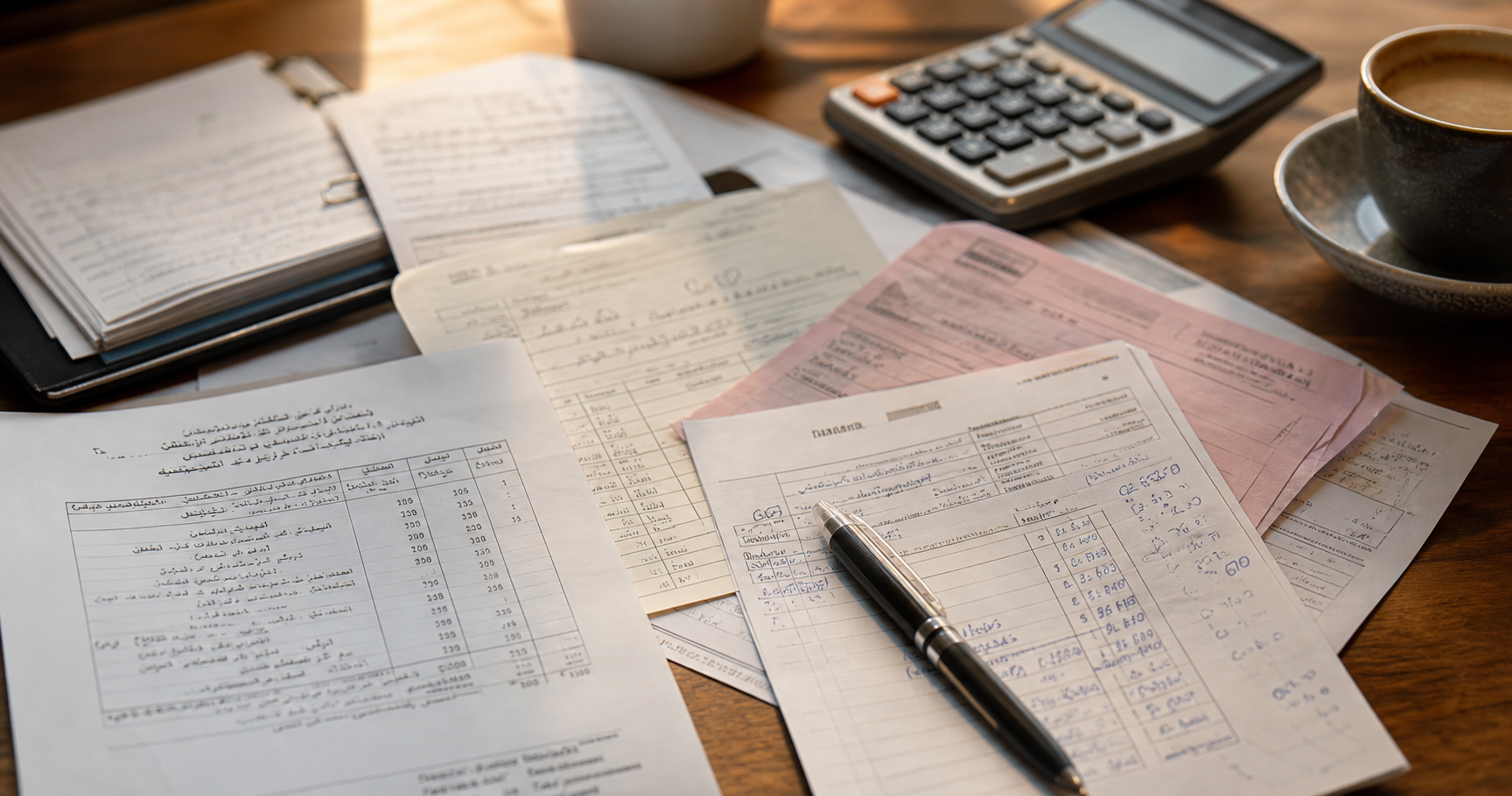
Larger Dubai and Abu Dhabi suppliers lean toward bilingual templates. Smaller construction and trading vendors in the northern emirates send looser, Arabic only documents. Multi-language invoice processing OCR software handles this format variety more reliably than generic tools. Format variety is the starting condition, not the exception.
Standard OCR was trained on Latin letterforms, and Arabic breaks that model in predictable ways. Right-to-left field order gets reversed during extraction, so a total that reads correctly to a human comes out backward in the data. Connected letterforms, where a character changes shape depending on its position in a word, confuse engines built to match static Latin glyphs. Faded thermal receipts and handwritten Arabic notes on delivery slips often return nothing at all.
Even when OCR reads the header correctly, the labor-intensive part is still ahead: line items, VAT treatment, and account coding stay untouched. Spreadsheets and generic scanning apps don't close this gap either. Someone still ends up copying values by hand once a bilingual invoice lands in the inbox.
| Where it breaks | Standard OCR | AI-based document processing |
|---|---|---|
| Right-to-left field order | Reverses fields, so a correct total comes out backward in the data | Reads context and position, keeping numerals and text correctly paired |
| Connected Arabic letterforms | Confused by letters that change shape depending on position in a word | Matches field meaning and relationships instead of fixed glyph shapes |
| Faded or handwritten documents | Often returns nothing at all | Flags unclear fields with confidence scoring instead of guessing |
| Line items and VAT coding | Left untouched even when the header is read correctly | Extracted and coded as part of the same pass |
| Reviewing the result | No translation, so a non-Arabic-reading reviewer can't verify it | Shows English translations next to the original Arabic text |
AI document processing handles Arabic invoices as a data structure problem, not a character recognition problem. Instead of matching pixels against known letterforms, the system reads context: what a field means given its position, its neighboring labels, and how similar invoices have been coded before. That distinction matters because Arabic labels move. الإجمالي (total) might sit top-right on one supplier's template and bottom-left on another's, and ضريبة القيمة المضافة (VAT) could appear as a full phrase, an abbreviation, or a stamped addition. A system trained on field relationships instead of fixed coordinates still connects the right label to the right value even as layout changes invoice to invoice. Pairing this with multilingual accounting software means extracted data lands in a ledger built to handle multiple languages.
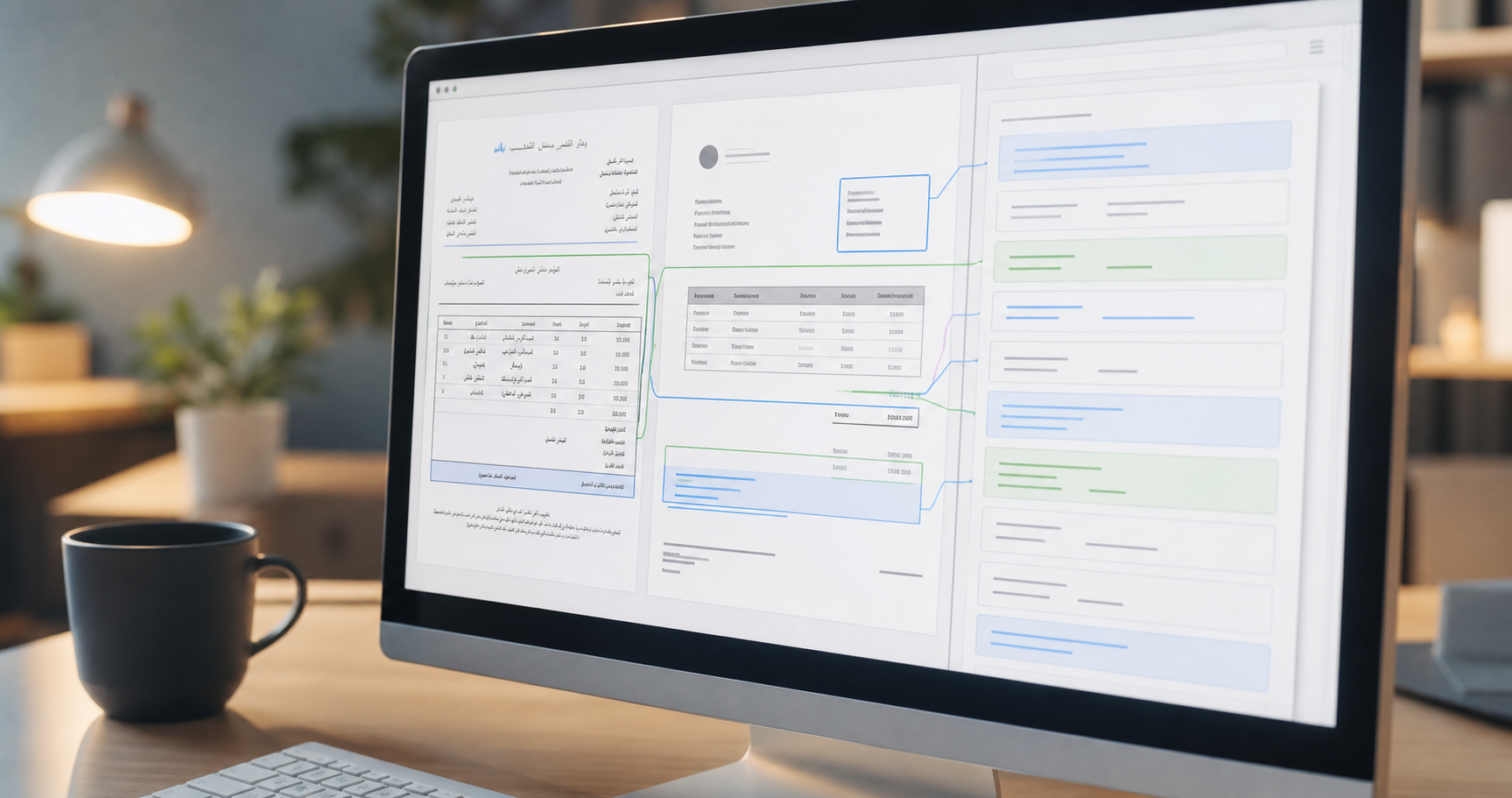
This same approach handles the right-to-left and left-to-right mixing common on bilingual invoices, keeping numerals, currency symbols, and Arabic text correctly paired instead of reversed during extraction.
When comparing Arabic invoice processing options, a few criteria separate tools that actually work from ones that look good in a demo.
Choosing a ledger platform and solving Arabic invoice intake are two separate decisions, and most "best accounting software UAE" roundups only answer the first one.
Zoho Books, Xero, QuickBooks Online, Tally, and the local accounting platforms common across UAE firms all handle the books once data reaches them: chart of accounts, VAT returns, reporting. Multi-currency invoice processing for accounting firms is a separate challenge that sits upstream of all of them. Zoho, Xero, and QuickBooks even support Arabic interface localization. That solves nothing for the invoice sitting in a supplier's inbox.
Interface language and document extraction are different problems. An Arabic menu doesn't help when someone still has to read the Arabic line items on a bilingual PDF, match them to the right VAT treatment, and key them into Zoho Books by hand. Getting that data to the ledger, correctly coded to the chart of accounts, is a separate step that has to happen first, regardless of which accounting software a UAE firm has already chosen.
Even after intake automation goes live, a few predictable breakdowns still surface mid-implementation.
Mismatched tax lines result when Arabic labels don't map cleanly to VAT codes. A supplier might write ضريبة القيمة المضافة in full on one invoice and abbreviate it as ض.ق.م on the next, a pattern one Dubai bookkeeper switching from Dext found repeatedly in his client documents, and a tool that recognizes only one variant posts the amount to the wrong tax rate or leaves it uncoded.
Duplicate detection also breaks when the same invoice number appears in Arabic-Indic numerals on one document and Western numerals on the reissued copy, so systems matching exact strings treat ٢٠٢٦-٠١٤ and 2026-014 as separate invoices and post the bill twice.
Tofu, an AI document processing platform, reads Arabic and bilingual invoices as part of its 200+ language support, with right-to-left interface handling built in, a capability one UAE firm processing 4,800 extractions a month relies on across 200+ clients. Extracted fields show English translations next to the original Arabic text during review, so a bookkeeper who doesn't read Arabic can still verify a total or a tax registration number against the source document. That review step stays quick: "What used to take me 3-4 hours can be done in 30-60 minutes," as Tammy Tan at Klozer puts it.
Cross-script supplier matching solves a problem that trips up simpler tools: a vendor invoiced once in Arabic and once under a romanized name still maps to the same contact, instead of creating a duplicate every time the spelling changes.
Tofu offers native two-way integration with Zoho Books, a common accounting software choice among UAE firms. Line items and tax treatment get extracted by default on every plan, including mixed VAT rates, Arabic-Indic numerals, and dual-script line items on one invoice.
You'll keep getting Arabic invoices in every shape suppliers send them, from dual column PDFs to handwritten totals on delivery slips, and that won't settle down just because the e-invoicing mandate is rolling out. Your chart of accounts and VAT codes only work if the Arabic data reaches them cleanly in the first place, and that step happens before your accounting software ever sees the document. Get that part right and reviewing invoices becomes a lot faster than retyping them. Feel free to book a demo with one of your own bilingual invoices in hand.
Standard OCR tools were trained on Latin letterforms and reverse right-to-left field order during extraction, so a correctly written total comes out backward in the data. Tofu reads Arabic invoices as a data structure problem, matching field meaning and position instead of fixed glyph shapes, and displays English translations next to the original Arabic text so a bookkeeper who doesn't read Arabic can still verify a tax registration number or line-item total against the source document.
Confirm the tool handles mixed Arabic and English on the same document, accepts PDFs, phone photos, and WhatsApp images (beyond clean scans), extracts every line item instead of header totals only, and flags unclear fields with confidence scoring instead of silently posting a guess. Tools that pass only a pure-Arabic demo often stumble on the bilingual PDFs a UAE supplier actually sends.
Yes. Tofu sits upstream of both systems as the document-processing layer, and it extracts Arabic and bilingual invoice fields, codes them to the chart of accounts, and publishes to Zoho Books or Xero. The Arabic extraction and right-to-left handling works within Tofu's standard workflow without requiring a switch of systems.
Systems that match on exact strings treat ٢٠٢٦-٠١٤ and 2026-014 as separate invoices and post the bill twice. Tofu's duplicate detection matches on invoice date, total amount, and contact instead of string equality, so a reissued copy with a different numeral system still gets flagged before it reaches the ledger.
Voluntary adoption of the FTA's phased e-invoicing system begins July 2026, with businesses at or above AED 50 million required to appoint an Accredited Service Provider by July 31, 2026, ahead of mandatory e-invoicing starting January 2027. During the transition, bilingual PDFs and Arabic paper invoices keep arriving alongside structured XML or UBL files, so getting Arabic data correctly coded before it reaches your accounting software remains a separate step from e-invoicing compliance itself.