SunTao Lai
May 28, 2026

Most people assume data entry and accounting jobs are interchangeable, or that one naturally turns into the other without any real shift in skills. That's half true. Data entry is a task accountants perform, but accounting is a profession that goes well beyond inputting numbers. The difference matters if you're deciding where to invest your time, whether to go after certifications, or which remote roles actually match your experience level. Knowing what each role demands keeps you from underselling yourself or applying for something you're not prepared for.
TLDR:
Data entry and accounting often get grouped together, but they describe very different scopes of work. Data entry is the act of capturing and transferring information: typing invoice details into a spreadsheet, uploading transactions into software, recording figures from a paper document into a database. The work is input-focused. Speed and accuracy matter most.
Accounting goes further. It takes that entered data and turns it into something useful: financial statements, tax filings, compliance reports, and strategic advice for clients or business owners. An accountant interprets what the numbers mean, beyond recording what they say.
The key relationship: data entry is something accountants do, but it's a small slice of what accounting actually is. A bookkeeper typing invoices all day is performing data entry. An accountant who reviews those entries, matches accounts, and advises a client on cash flow is doing accounting. Same data. Completely different job.
Salaries vary quite a bit depending on whether you're doing data entry, accounting clerk work, or something in between. Understanding where each role sits helps you make a smarter decision about which path to pursue.
In the United States, according to BLS occupational data, data entry salaries generally fall between $30,000 and $40,000 per year for full-time roles.
Remote and work-from-home data entry jobs often pay on the lower end, particularly for contract or per-task arrangements. That said, specialized data entry roles tied to financial data capture and entry in accounting software can command higher rates given the precision required.
| Role | Typical Annual Salary (US) |
|---|---|
| Data entry clerk | $30,000 to $38,000 |
| Accounting data entry specialist | $38,000 to $45,000 |
| Accounting clerk | $42,000 to $52,000 |
| Bookkeeper | $48,000 to $58,000 |
The difference comes down to scope. Data entry jobs for beginners require accuracy and speed, but limited financial judgment. Accounting clerk roles require you to understand what the numbers mean, apply account codes correctly, and catch errors that carry real consequences.
Certifications, experience with accounting software, and the ability to handle full-cycle accounts payable or receivable all push your salary upward, regardless of which side of the data entry and accounting divide you start on.
Most data entry roles ask for a short list of skills, which is exactly what makes them accessible to career starters and people switching from unrelated fields.
Here are the core requirements:

Formal education requirements are minimal. Most employers look for a high school diploma and train from there. No accounting degree or certifications are needed to get started, which is why data entry jobs for beginners and people with no experience remain one of the most accessible entry points into office and accounting support work.
Accounting careers typically require a formal credential. Most entry-level roles expect at least an associate degree in accounting or finance, while senior positions often require a bachelor's degree or a professional certification like a CPA (Certified Public Accountant) or CMA (Certified Management Accountant).
Beyond degrees, employers look for proficiency in accounting software such as QuickBooks, Xero, or Sage, along with a working knowledge of GAAP or IFRS standards depending on your region.
Here are the core qualifications most accounting employers expect:
Some roles, particularly in public accounting or corporate finance, also expect knowledge of tax codes, payroll regulations, or industry-specific reporting requirements. The barrier to entry is higher than in data entry, but so is the earning potential.
Remote and work-from-home data entry roles have grown steadily as companies across industries accept distributed teams. For beginners especially, these positions offer a low-barrier entry point into professional work with flexible scheduling.
Several categories of remote data entry work are worth knowing before you apply:
Pay varies by role type and experience level. Entry-level remote positions often start around $12 to $15 per hour in the US, while accounting-specific data entry roles with some bookkeeping knowledge can reach $18 to $22 per hour. Specialized roles involving financial data entry in accounting software tend to sit at the higher end of that range.
No formal qualifications are required for most beginner roles, but showing accuracy, a typing speed above 45 WPM, and basic spreadsheet knowledge will separate your application from the pack.
Choosing the right tools matters whether you're handling basic data entry or full accounting workflows. The software you use shapes how fast you work, how many errors slip through, and how much of your day gets spent on repetitive input.
Manual data entry into any of these tools is where time gets lost, which is why firms are learning how to automate invoice processing. A bookkeeper processing supplier invoices still has to open each document, read it, and type every field by hand. Tofu sits before your accounting software as the document processing layer, extracting line items, learning your coding preferences, and publishing directly to Xero or QuickBooks Online via native integration. What used to take hours gets done in a fraction of the time, without sacrificing accuracy.
Many people start in data entry and find it opens doors to accounting and finance roles over time. The path is not always linear, but the skills you build, like accuracy, software fluency, and an eye for financial data, translate well across both fields.
Here is how career progression typically looks for someone starting in data entry:
Remote work has expanded what is possible at every stage of this path. Data entry jobs online from home now appear at every level, from entry clerk to senior accounts roles, which means geography is less of a barrier than it was a decade ago.
Salary growth reflects this progression. Entry-level data entry roles typically pay between $30,000 and $40,000 annually in the US, while experienced bookkeepers and junior accountants can earn $50,000 to $70,000 or more, depending on specialization and location.
The clearest signal that you are ready to move up is when you stop just entering data and start asking why the numbers look the way they do.
Accounting automation software and AI are quietly retiring the repetitive parts of accounting work. As software handles more transaction coding, bank reconciliation, and document extraction, accountants who once spent hours on data entry are being pushed toward higher-value work: analysis, forecasting, tax planning, and client advisory.
The World Economic Forum projects 85 million jobs will be displaced by automation by 2025, while 97 million new roles appear that require human judgment and interpersonal skills. In accounting, that shift is already visible.
Firms that adopt AI document processing tools free their staff from repetitive input tasks. Instead of keying invoices, bookkeepers review AI-coded transactions. Instead of chasing receipts, accountants consult on cash flow.
The accountants who adapt to this shift treat AI bookkeeping as a skill multiplier. The ones who resist it risk being undercut by smaller, leaner firms that process the same volume with half the staff.
Accounting firms processing high invoice volumes know the bottleneck well: a document arrives, someone opens it, and the manual typing begins. Supplier name, date, amount, every line item, one by one. That work sits entirely outside what accounting software was built to do.
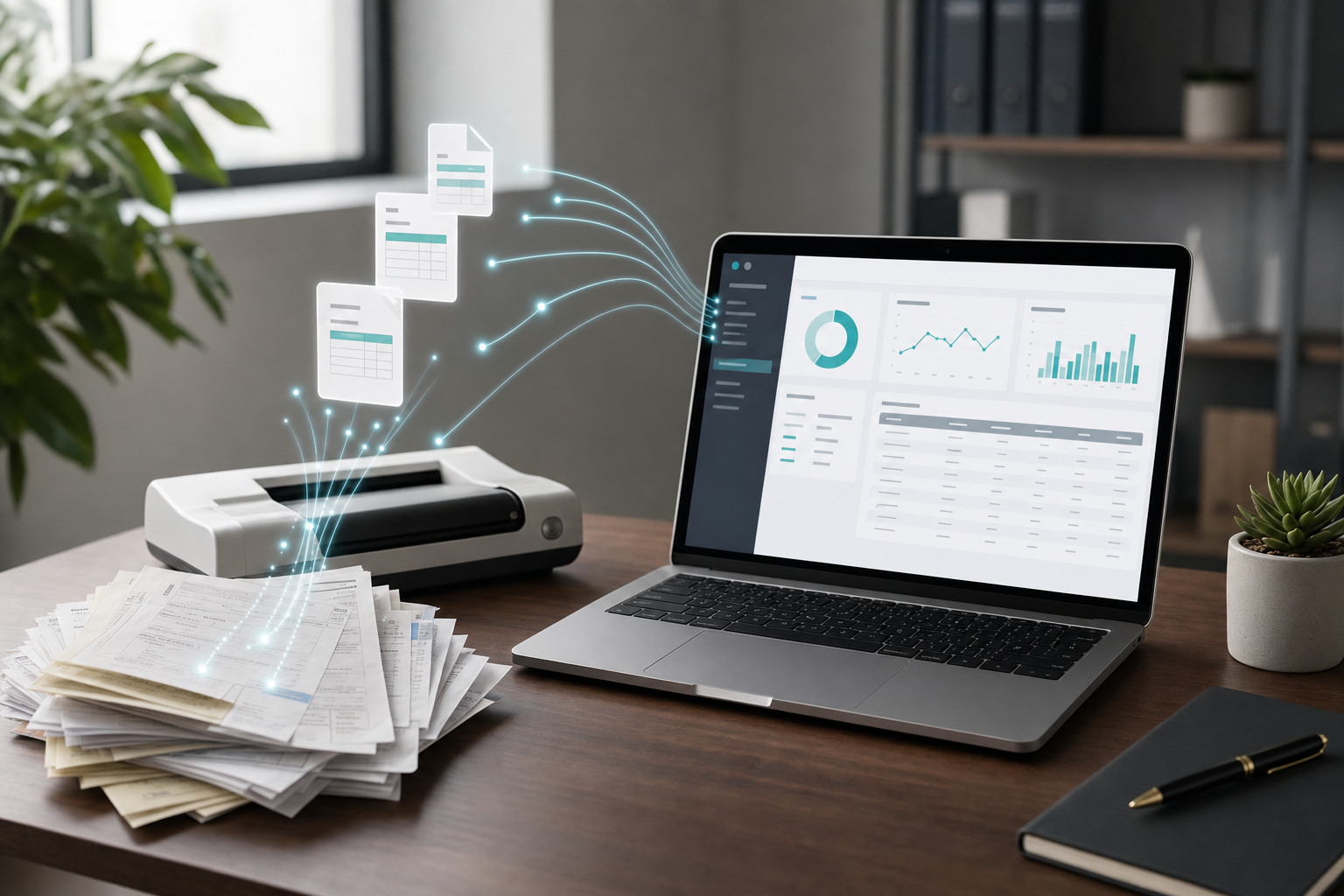
Tofu AI is an AI document processing tool that sits before your accounting software. Upload invoices, receipts, or bank statements, and Tofu extracts every line item with automated invoice data capture, learns your coding preferences over time, and publishes directly to Xero or QuickBooks Online via native integration.
The more you process, the more Tofu learns. It remembers how you code a specific supplier, which account a particular expense maps to, and how your chart of accounts is structured.
"What used to take me 3-4 hours can be done in 30-60 minutes." - Tammy Tan, Klozer
Tofu handles 200+ languages including handwriting with OCR accounting software, so documents from international suppliers go through the same workflow as any other file. No manual translation, no workarounds.
The line between data entry and accounting matters more than most job descriptions admit. Data entry is where you start, accounting is where you grow, and the transition depends on how fast you move from recording numbers to interpreting what they mean. Remote opportunities exist at every level now, so geography matters less than it used to. If you're ready to see how document processing automation actually works in practice, book a quick demo and watch invoices get coded in real time.
Data entry is the act of inputting information into systems — typing invoice details, uploading transactions, recording figures from documents. Accounting takes that data and turns it into financial statements, tax filings, compliance reports, and strategic advice. Data entry is something accountants do, but it's a small slice of what accounting actually is.
Yes. Most data entry roles require only a high school diploma, typing speed of 40-50 WPM, and basic spreadsheet knowledge. Formal accounting education is not required for entry-level positions, which is why data entry jobs for beginners remain one of the most accessible entry points into office and financial support work.
Remote and work-from-home data entry jobs often pay on the lower end of the range, particularly for contract or per-task arrangements. Entry-level remote positions typically start around $12 to $15 per hour in the US, while accounting-specific data entry roles requiring some bookkeeping knowledge can reach $18 to $22 per hour. In-office positions may offer slightly higher base rates but lack the flexibility and commute cost savings.
Accounting firms typically use QuickBooks and Xero for small to mid-sized clients, with Sage and MYOB for larger or compliance-heavy environments. For data entry in particular, Microsoft Excel and Google Sheets handle basic tasks, but AI document processing platforms like Tofu sit before accounting software as the extraction layer — pulling line items from invoices and receipts, learning coding preferences, and publishing directly to Xero or QuickBooks Online without manual re-entry.
Start in entry-level data entry processing invoices or payroll records to gain exposure to accounting workflows. After 1-2 years, move into accounts payable clerk, bookkeeper, or junior accountant roles where you review and match data instead of just inputting it. Add certifications like a CPA or accounting certificate to advance to senior bookkeeper, accountant, or financial analyst positions earning $50,000 to $70,000+ annually.