SunTao Lai
May 11, 2026

Forty minutes of manual data entry per bank statement, per client. That's what it costs when Bank of Valletta and the other local banks don't connect to Xero. Someone on your team downloads the PDF, opens it, and types every line. Then you do it again next month. Best accounting software Malta firms are using now can read those PDFs, extract every transaction, and publish directly to Xero while handling invoices in Italian, Arabic, and Maltese without breaking.
TLDR:
Bookkeeping automation software uses AI to extract financial data from invoices, receipts, and bank statements, then posts that data directly into accounting systems like Xero or QuickBooks. The accountant reviews and approves instead of typing.
In Malta, the problem is concrete. Malta's major banks don't offer direct Xero integration, so every bank statement lands as a PDF. That means manual data entry for every transaction, every month, for every client.

We tested each tool against six criteria tied directly to how Malta accounting firms actually work.
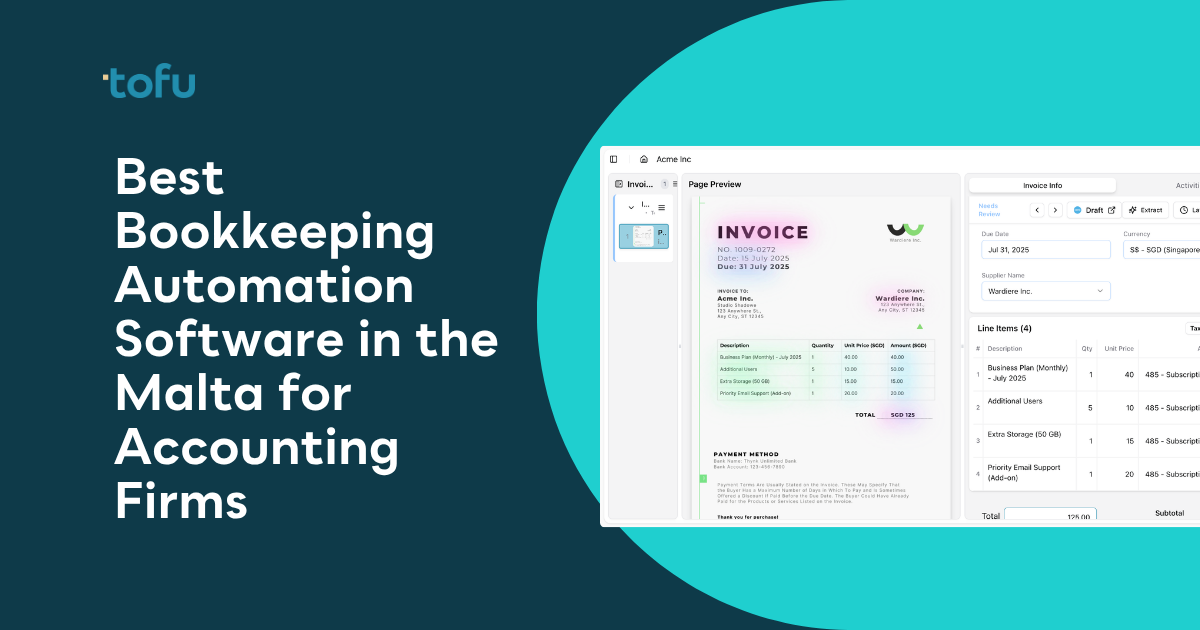
Tofu is built for accounting firms processing high volumes of invoices, receipts, and bank statements. You upload a document, Tofu extracts every line item, applies your chart of accounts coding, and publishes directly to Xero. No manual re-entry.
Malta's accounting firms often handle multilingual clients across the EU. Xero adoption in Malta has grown rapidly through local Platinum partners, making Xero integration a practical requirement for bookkeeping tools. Tofu processes documents in 200+ languages, including handwriting, which matters when clients send invoices in Italian, Arabic, or Maltese.
"What used to take me 3-4 hours can be done in 30-60 minutes." — Tammy Tan, Klozer
Tofu connects directly to Xero, which is widely used across Malta. Once a document is processed, you review, approve, and publish. The firm's time goes toward reviewing work, not producing it.
DOKKA is a cloud-based bookkeeping automation tool built for accounting firms that want to reduce manual data entry across invoices and other financial documents. It sits in the mid-tier of the market, offering document capture, AI-assisted coding, and accounting software integrations.
It connects with Xero and QuickBooks, which makes it a workable option for firms already running those setups in Malta. The AI learns from past coding decisions over time, which reduces repetitive manual corrections for recurring suppliers.
That said, DOKKA is primarily built for the Israeli and broader European market, and its local support and Malta-specific configuration experience is limited compared to tools with dedicated regional presence.
Datamolino uses OCR with a human-in-the-loop verification layer. For difficult documents, that process can take up to 24 hours.
What it offers:
It works reasonably well for UK or Australian firms processing clean, English-language invoices where next-day turnaround is acceptable.
Two issues disqualify it for most Malta firms. First, Datamolino only supports Latin-script languages, which means Italian supplier invoices process fine, but Arabic, Greek, or any non-Latin document will cause problems. Second, the 24-hour verification window is a real constraint during busy periods like VAT submission deadlines, where same-day processing matters.
AutoEntry is a receipt and invoice capture tool built by Surf Accounts, now part of the Bright suite. It has been used by accounting firms across Ireland and the UK for years, and has some presence in Malta through Bright's regional expansion.
The tool handles photo capture, PDF uploads, and basic bank statement processing. Extracted data publishes to Xero, QuickBooks, and Sage.
That said, AutoEntry has known limitations around line-item extraction accuracy and multi-language document support, which matters for Maltese firms handling Italian, Arabic, or mixed-language supplier invoices.
Hubdoc is a document collection and data extraction tool that integrates tightly with Xero and QuickBooks. Accounting firms in Malta use it mainly to collect supplier documents from clients and pull basic header data from invoices and receipts.
It handles the fetch-and-file side of bookkeeping reasonably well. Clients can email, photograph, or upload documents, and Hubdoc attempts to extract supplier names, dates, and totals before pushing records to Xero.
Where it falls short is depth. Hubdoc captures headers and totals, not line items, which means your staff still manually codes the detail. For firms processing high volumes of multi-line invoices, that gap adds up fast.
Dext is a document capture tool used by accounting firms across the UK, Australia, and Malta. It connects with Xero and QuickBooks, pulls in receipts and invoices, and pushes extracted data to your general ledger.
For Maltese firms already running Xero, Dext fits naturally into that workflow. You get supplier rules, automated categorisation, and a client-facing mobile app for receipt submission.
That said, Dext is built around header-level extraction by default. Getting full line-item detail typically requires additional configuration, and pricing scales per client, which adds up quickly for growing firms.
Here's how the six tools compare across the criteria that matter most for Malta-based accounting firms.
| Feature | Tofu | DOKKA | Datamolino | AutoEntry | HubDoc | Dext |
|---|---|---|---|---|---|---|
| Line-item extraction included | Yes | Yes | Yes | No (2 credits) | No | No (credits) |
| Bank of Valletta PDF processing | Yes | Limited | Yes | Yes | CSV only | Yes |
| Multilingual (Arabic, Italian) | Yes (200+) | No | No (Latin only) | No | No | No (Latin only) |
| Malta VAT rates (18%, 12%, 7%, 5%) | Yes | Yes | Yes | Yes | No | Yes |
| Xero native integration | Yes | Yes | Yes | Yes | Yes | Yes |
| Flat pricing (no per-document) | Yes | No | No | No | Yes (free) | No |
| Handwriting recognition | Yes | No | No | No | No | No |
A few things stand out here. Multilingual support is a real differentiator for Malta, where Arabic and Italian documents arrive regularly from clients in North Africa and Southern Europe. Only Tofu covers 200+ languages, including handwriting. On pricing, most tools charge per document or per credit, which makes monthly costs unpredictable at volume. HubDoc is free but skips Malta VAT rates entirely, which creates gaps during reconciliation.
Tofu was built for exactly the kind of work Malta accounting firms do every day: processing stacks of invoices and receipts across multiple clients, coding transactions to the right accounts, and publishing to Xero before month-end.

Most bookkeeping tools stop at reading a document. Tofu goes further. It extracts every line item, learns your chart of accounts, applies the right codes automatically, and publishes directly to Xero. No reformatting. No manual entry.
For firms handling multilingual documents, Tofu reads 200+ languages, including handwriting. That matters in Malta, where suppliers from across Europe send documents in a dozen different formats.
Your firm's time goes to clients, not retyping what's already on an invoice. Tofu should handle the documents your clients actually send, including handwriting, multilingual invoices, and bank PDFs that lack direct Xero feeds. Tofu processes all of it and publishes straight to your accounting system without per-document fees or language restrictions. Upload a few sample files and watch how it codes them to your chart of accounts.
Tofu processes documents in 200+ languages including English, Maltese, Italian, and Arabic without requiring language selection. Other tools like Datamolino and Dext only support Latin-script languages, which creates problems when processing Arabic or non-Latin supplier documents common in Malta's cross-border trade.
Flat-rate pricing (like Tofu's $199/month for 50 clients) makes costs predictable as your client volume grows. Per-document pricing can become expensive quickly during busy periods like VAT deadlines. Calculate your average monthly document volume and compare total costs across both models before committing.
Header-only tools (HubDoc, basic Dext) capture supplier name, date, and total amount — you still manually code each line item. Line-item extraction reads every line including descriptions, quantities, unit prices, and account codes automatically. For a 30-line wholesale invoice, that's the difference between 5 minutes and 40 minutes of manual work.
Most tools can process standard bank statement PDFs, but check for compatibility with Malta bank formats. Tofu processes Bank of Valletta, APS Bank, and BNF Bank PDFs directly. HubDoc requires CSV conversion first, which adds an extra step to your workflow.
If your team spends more than 10 hours per week typing invoices and receipts, or you're processing bank statements that take 30+ minutes each, automation pays for itself immediately. The break-even point is typically 2-3 hours of saved bookkeeper time per month.