
SunTao Lai
May 11, 2026

MTD income tax went live three months ago, which means you're now doing quarterly prep for every client earning over £50,000. That wouldn't be a problem if your document processing tool actually reduced manual work, but most of you are still correcting line items, chasing missing VAT codes, and paying per-document fees that climb faster than your client list. We ranked five bookkeeping automation software for UK firms on the things that matter when you're processing high volumes: line-item accuracy, mixed VAT rate handling, flat pricing models, and whether the tool learns your coding patterns or makes you teach it every time.
TLDR:
We scored each tool across five categories that matter to UK accounting practices: receipt and invoice capture accuracy, accounting software integrations (Xero, QuickBooks, Sage), UK VAT handling, pricing relative to client volume, and how much manual correction work gets left behind after processing.

We tested tools hands-on where possible and drew on verified user reviews from Capterra, G2, and the ICAEW community forums. Pricing was verified directly from each vendor's published UK pricing pages as of early 2026.
Tools were excluded if they lacked a direct Xero or QuickBooks integration, had no UK-based support or documentation, or required enterprise contracts without transparent pricing. That left a shortlist of tools that UK accounting firms can actually assess and adopt without a procurement team.
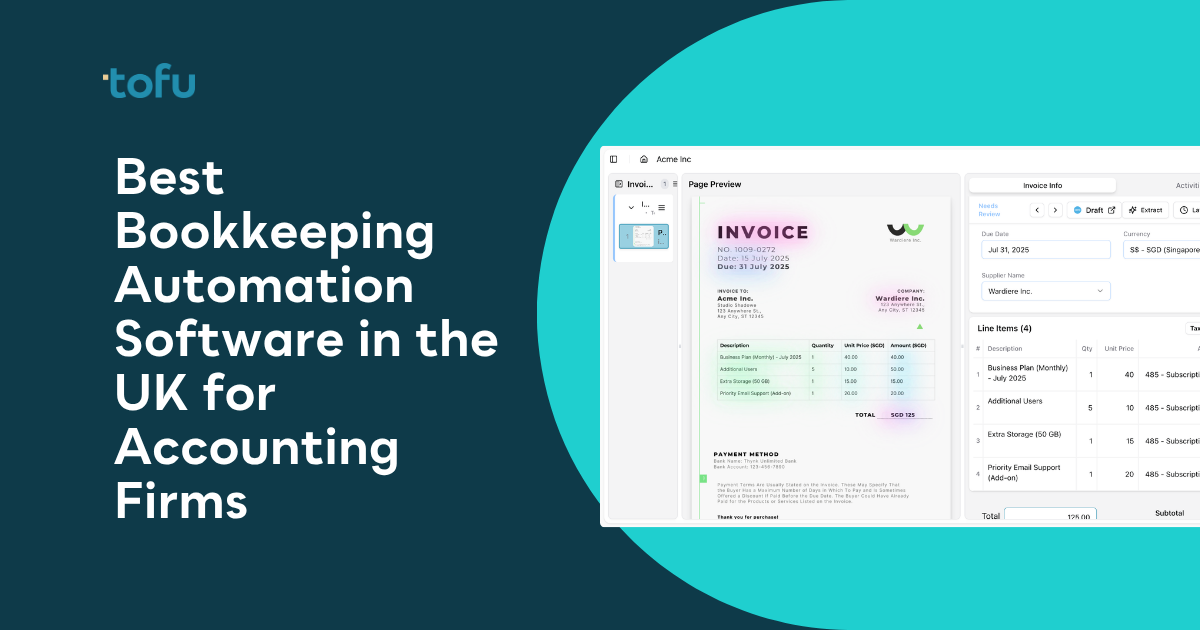
Tofu was built for accounting firms processing high volumes of invoices, receipts, and bank statements. Where most tools stop at reading a document, Tofu extracts every line item, applies your chart of accounts, and publishes directly to Xero or QuickBooks while learning your coding preferences as it goes.
Setup takes around 15 minutes per client. There's no per-document pricing, no per-user seat fees. One flat subscription covers your whole firm.
Customers describe the difference plainly. "What used to take me 3-4 hours can be done in 30-60 minutes," says Tammy Tan of Klozer. Some have coined their own shorthand for it: "Can you Tofu it? If you can, please just load it in. Don't think."
| Plan | Price | Documents/month |
|---|---|---|
| Starter | From £99/month | Up to 500 |
| Growth | From £199/month | Up to 2,000 |
| Enterprise | Custom | Unlimited |
Tofu is best suited to firms processing consistent document volumes across multiple clients who want a tool that codes instead of just capturing.
Dext is a document capture tool among UK accounting firms. It connects with Xero, QuickBooks, and Sage, and handles receipt and invoice capture reasonably well for straightforward documents.
That said, firms processing high volumes of supplier invoices often run into its limits. Line-item extraction requires manual intervention more often than the pricing suggests it should, and costs can climb quickly as document volume grows.
Pricing starts around £38/month for sole traders, with firm plans varying based on client count. It sits at the more expensive end of the UK market for what it delivers on line-item accuracy.
If your firm processes mostly simple receipts and bank feeds, Dext covers the basics. For firms with complex, multi-line invoices or documents in non-Latin scripts, you may find yourself doing more cleanup than expected.
Hubdoc is a document capture tool built into Xero. It lets clients submit receipts and invoices by email, mobile upload, or direct supplier fetch, then publishes the extracted data to Xero or QuickBooks.
For UK accounting firms already running Xero, Hubdoc has the advantage of being included in Xero's business plans at no extra cost. Setup is straightforward, and the supplier fetch feature can pull bills automatically from supported utilities and telecoms providers.
The tradeoffs are real, though. Extraction accuracy drops on anything outside clean, standard invoices. Line-item detail is limited, and the AI learning capability is minimal compared to newer tools. Firms processing high document volumes or complex supplier invoices often find Hubdoc creates as much correction work as it saves.
It works well in that narrow context. For firms scaling document volume or handling multi-line purchase invoices across diverse suppliers, the accuracy limitations tend to surface quickly.
AutoEntry, now owned by Surf Accounts, is a document capture tool aimed at small businesses and accounting practices across Ireland and the UK.
It handles invoice, receipt, and bank statement capture, with data published to accounting software like Xero, QuickBooks, and Sage. The interface is straightforward, and it covers the basics most firms need for day-to-day document processing.
That said, AutoEntry sits at the simpler end of the market. Line-item extraction is available but limited compared to newer AI-driven tools, and firms processing high volumes or complex supplier documents often find the accuracy inconsistent. Reviews on G2 reflect this, with users citing occasional extraction errors and a support experience that has declined since the Surf Accounts acquisition.
Pricing is credit-based, which works for low-volume firms but becomes unpredictable as client numbers grow.
Datamolino is a data extraction tool built for accountants, focused on pulling line items from invoices and bills before pushing them to Xero or QuickBooks.
It handles multi-line invoice extraction reasonably well, and its folder-based client organisation appeals to firms managing many clients at once. The approval workflow is straightforward, and the interface is clean enough that bookkeepers can get going without much training.
That said, Datamolino sits in a narrower category. It covers invoices and bills, but firms processing bank statements or a wider range of document types will quickly find gaps. Pricing scales per document, which can catch firms off guard as volume grows.
For UK accounting firms wanting solid invoice extraction with Xero or QuickBooks integration, Datamolino is a competent option worth considering alongside broader tools.
The table below covers the features that matter most to UK accounting firms processing high document volumes. Costs shown reflect published pricing for a 50-client firm at typical monthly volume.

| Feature | Tofu | Dext | Hubdoc | AutoEntry | Datamolino |
|---|---|---|---|---|---|
| Line-item extraction (no extra cost) | Yes | No (credits) | No | No (2x credits) | Yes |
| Mixed VAT rate handling | Yes | Yes | No | Yes | Yes |
| MTD compliance ready | Yes | Yes | Limited | Yes | Yes |
| Multilingual (200+ languages) | Yes | No | No (English only) | No (English only) | No (Latin scripts) |
| Handwriting recognition | Yes | Limited | No | No | Yes (24hr delay) |
| Bank statements (unlimited) | Yes | No (credits) | CSV only | No (3 credits/page) | No (per-page charge) |
| Flat pricing (no per-document fees) | Yes | No | Yes (bundled) | No | No |
| Zero-configuration setup | Yes | No | No | No | No |
| Processing speed | Under 10 sec | Minutes | Variable | 2-6 hours | Up to 24 hours |
| 50-client monthly cost | £160 | ~£849 | Free with Xero | ~£298 | ~£212 |
A few things stand out. Tofu is the only tool offering multilingual extraction across 200+ languages with handwriting recognition at no added cost, which matters for firms handling documents from international clients. It is also the only one with zero-configuration setup, meaning no per-client onboarding before you can start processing.
MTD for income tax went live in April 2026. Individuals earning over £50,000 now need to keep digital records and submit quarterly updates to HMRC, which means the accounting firms serving them need document processing that handles quarterly prep without adding manual overhead on top of an already stretched workload.
Tofu fits this regulatory moment precisely. Mixed VAT coding happens automatically at the line-item level. Client-specific chart of accounts patterns are learned without any setup work from your team. And at roughly 75% less than per-client pricing models at scale, the economics are hard to argue with.
UK firms are also rethinking their stacks right now. Hubdoc has stalled, Dext pricing keeps climbing. That combination of regulatory pressure and vendor friction makes this a good time to move. Tofu delivers what this moment requires, at a price that makes the decision straightforward.
Your choice of bookkeeping automation software in the UK should match the complexity and volume your firm actually handles. Basic receipt capture works until you're processing multi-line purchase invoices with mixed VAT rates across 50 clients. That's where most tools create cleanup work instead of saving time. Tofu was built for exactly that workload, and the pricing structure reflects it. Try a demo with your firm's actual documents to see the difference. You'll know pretty quickly if it handles what you throw at it.
Tofu processes documents in 200+ languages including handwriting and non-Latin scripts, making it the strongest option for firms with international clients. Dext, Hubdoc, and AutoEntry are limited to English and Latin alphabets.
Flat pricing makes sense when processing consistent monthly volumes across multiple clients: you pay the same whether you process 400 or 500 documents. Per-document pricing can work for firms with unpredictable workloads, but costs become difficult to forecast as client numbers grow.
Tofu and Datamolino both extract line items as standard. Dext requires purchasing additional credits for line-item extraction, and Hubdoc doesn't support it at all. AutoEntry charges double credits per page for line-item processing.
Document capture tools read invoices and give you totals to copy-paste. Bookkeeping automation extracts every line item, applies your chart of accounts, learns your coding patterns, and publishes directly to your accounting software with no manual entry required.
Tofu handles mixed VAT coding at the line-item level without manual setup. Dext and AutoEntry support this as well, but Hubdoc's VAT handling is limited and often requires manual correction when processing complex supplier invoices.