SunTao Lai
March 23, 2026


Most accounting software solutions in Malaysia assume you picked one system and stuck with it. Your firm doesn't work that way. You've got clients on SQL Accounting who started there a decade ago, new startups on Xero, and everyone else scattered across AutoCount and QNE. Then there's the language problem: Chinese invoices from Penang suppliers, Malay purchase orders from local contractors, English receipts from international vendors. The automation tools everyone recommends can't handle either challenge. Here's what actually works when you need to process multilingual documents across multiple accounting systems without hiring three more bookkeepers.
TLDR:
Malaysian accounting firms don't pick one accounting software and stick with it. They run three, sometimes four different systems at once.
Walk into any mid-sized firm in Kuala Lumpur and you'll find SQL Accounting or AutoCount handling long-standing local clients who started on desktop software years ago and never migrated. QNE covers clients who prefer locally-developed solutions with Malaysian tax workflows baked in. Xero or QuickBooks Online serves the international-facing clients: exporters, regional subsidiaries, or startups backed by foreign investors who expect cloud software.
Each system has its own chart of accounts structure, its own import format, and its own quirks. A bookkeeper processing 50 clients across four different software packages can't rely on a single workflow. They're context-switching all day.
This is where most global automation tools break. HubDoc and Dext were built for single-system firms in Australia or the UK. They publish directly to Xero or QuickBooks, but offer no path forward for SQL Accounting, AutoCount, or QNE users.
A Malaysian accounting firm serving 50 clients sees invoices in three or four languages every single day. Mandarin Chinese from electronics suppliers in Penang. Bahasa Malaysia from local contractors and government vendors. English from international service providers. Tamil from restaurant clients. All feeding into the same client entity's books.
HubDoc and Dext read English invoices reasonably well. Upload a Chinese fapiao or a Malay purchase order and they return nothing useful. The supplier name becomes garbled characters. Line item descriptions disappear. The bookkeeper opens the PDF side-by-side with their accounting software and types every field manually.
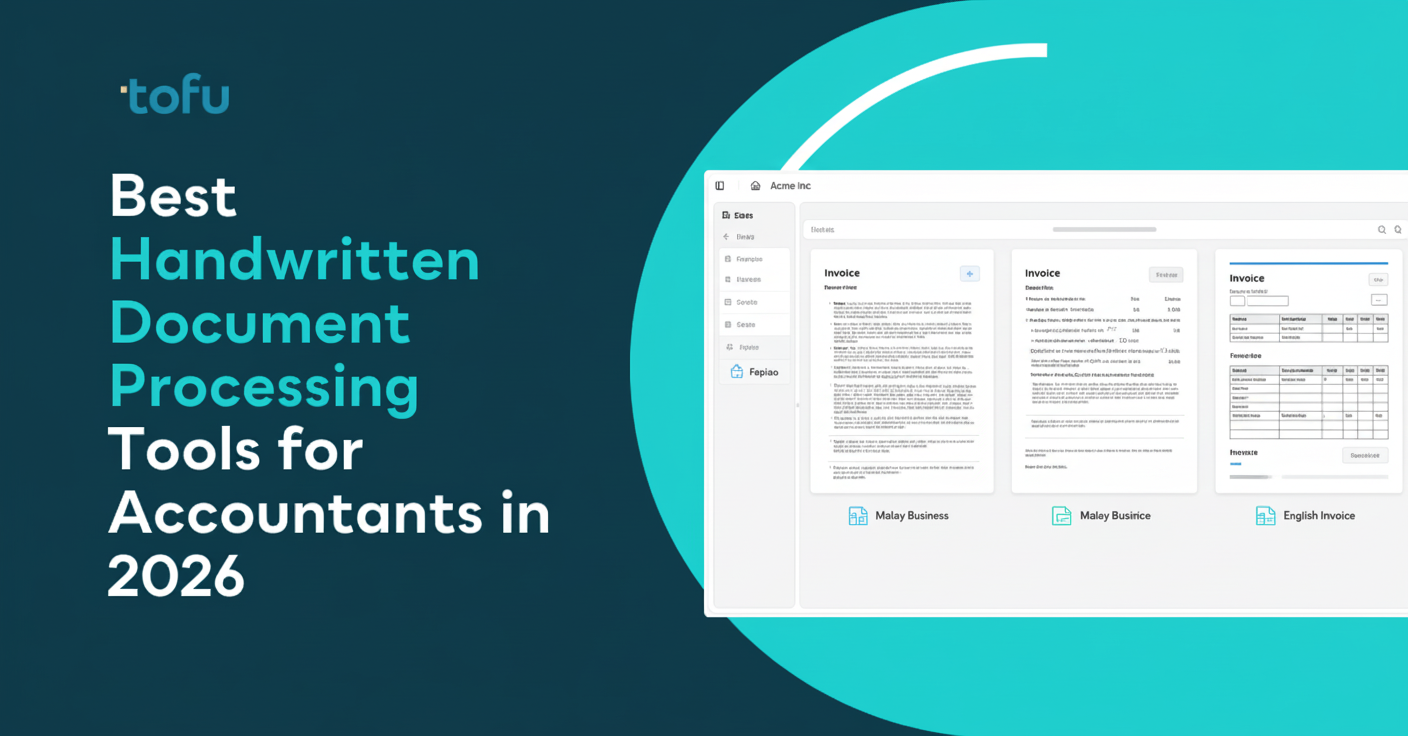
Tofu processes documents in over 200 languages without requiring language selection first. Upload a Chinese invoice and English translations appear side-by-side with the original text. The same workflow works for Malay, Tamil, Thai, and Arabic documents. No templates. No language packs. No configuration.
Legacy OCR tools fail on Chinese fapiao because they rely on template matching. The software needs to know where to find the supplier name, tax number, and line items. Different invoice layouts require different templates. A firm with 200 suppliers across multiple countries would need hundreds of templates before processing anything.
Tofu's AI reads the entire document and identifies what each field represents based on context and position. A Chinese fapiao with vertical text, a Bahasa Malaysia purchase order with mixed formatting, and an English invoice with tables all get processed the same way: upload, extract, review.
The AI translates non-English text into English automatically and displays both versions side-by-side. A bookkeeper reviewing a Mandarin invoice sees the original supplier name 北京科技有限公司 next to "Beijing Technology Co Ltd" without opening another tab.
When configuration time drops to zero, automation becomes viable for firms serving diverse client bases across multiple languages.
Xero and QuickBooks Online users connect their accounting file to Tofu, upload invoices or receipts, review the extracted data, and click publish. The transaction posts directly into your client's books with the source document attached. No CSV files. No manual imports.
For SQL Accounting, AutoCount, and QNE users, Tofu extracts the same data but outputs it as a structured CSV file formatted for import. Download the file, open your desktop software, and run the import function. The data maps to your chart of accounts because Tofu learned the coding patterns when you uploaded historical ledgers during setup.
Both workflows save time on extraction. The difference is the final step: one-click publish vs. one-click download and import. Malaysian firms need both options because client preferences vary. Your Xero clients get direct posting. Your SQL Accounting clients get CSV imports.
| Feature | Tofu | HubDoc | Dext |
|---|---|---|---|
| SQL Accounting Support | CSV export formatted for direct import with chart of accounts mapping | No support for SQL Accounting | No support for SQL Accounting |
| AutoCount and QNE Support | CSV export formatted for direct import with chart of accounts mapping | No support for AutoCount or QNE | No support for AutoCount or QNE |
| Xero and QuickBooks Integration | Direct one-click publishing with source documents attached | Direct publishing to Xero and QuickBooks | Direct publishing to Xero and QuickBooks |
| Chinese and Malay Document Processing | Processes 200+ languages including Chinese, Malay, and Tamil with automatic English translation displayed side-by-side | English and limited Latin alphabet support only | English and limited Latin alphabet support only |
| Line Item Extraction | Full line-item extraction from invoices and bank statements with account code suggestions | Header totals only, no line-item extraction | Header totals only, no line-item extraction |
| Configuration Time | Under 10 minutes, AI learns from historical ledgers automatically | Template configuration required for each vendor and document type | Template configuration required for each vendor and document type |
A bookkeeper in Malaysia earns between RM2,500 and RM4,000 per month. Break that down to hourly cost: roughly RM15 to RM25 per hour. Every hour saved on invoice typing and bank statement entry is an hour that doesn't need to be paid for.
Tofu's Business Plan costs RM880 per month and covers 50 clients. If your bookkeepers save 3 hours per week processing client documents, that's 12 hours per month. At RM20/hour, you're avoiding RM240 in labor costs each month. The software pays for itself after roughly 3.5 weeks.
The bigger opportunity is capacity expansion. Those 12 hours per month get reallocated to client advisory work, month-end review, or onboarding new clients. A firm saving 15 hours per week across the team can take on 8 to 10 additional clients without hiring another bookkeeper.
If your firm charges RM500 per client for bookkeeping, 10 new clients bring RM5,000 monthly recurring revenue with no proportional increase in headcount.
Seven of the top 10 global accounting networks use Tofu, including Baker Tilly and RSM. Both networks have member firms across Malaysia processing client documents through the same AI extraction workflow.

Malaysian firms already using Tofu include Klozer, MFD Advisory, and Accounting Superhero. Klozer cut bookkeeping to 1 hour per client batch. MFD Advisory processes QuickBooks invoices for CFO advisory clients. Accounting Superhero moved to Tofu after waiting two years for line-item extraction from their previous provider that never arrived.
When comparing automation software, the first question is always: "Who else is using this?" Knowing that member firms of Baker Tilly Malaysia or RSM Malaysia trust the same stack reduces implementation risk and shortens internal approval.
Sign up at gotofu.com and start with your hardest document first. Chinese fapiao from a supplier in Penang. Bahasa Malaysia purchase order from a local contractor. Multi-page bank statement from Maybank. Upload it and see what comes back.
Connect your Xero or QuickBooks account, or upload a historical general ledger CSV. Tofu reads your existing chart of accounts and starts coding right away. Setup takes under 10 minutes.
During your trial, test the documents that break other tools: handwritten receipts, mixed-language invoices, statements with 50+ transactions. Upload five invoices from your most complex client and review extraction accuracy against what you'd type manually.
Configuration time is the hidden cost that kills automation ROI. Setting up different extraction rules for each accounting software, teaching the tool where to find account codes for each client, building vendor lists manually: most firms give up before they finish.
Tofu reads your historical ledger or connects to your accounting software and learns immediately. A Chinese invoice going into SQL Accounting and an English receipt going into Xero both get processed through the same AI. No separate workflows. No language selection. No templates for different invoice formats.
Your team uploads the document. Tofu extracts it. Someone reviews and publishes or exports. The same steps work whether the client uses desktop software or cloud software, whether the document is in Mandarin or Malay.
The Business Plan covers 50 clients at RM880 per month with unlimited users. Your entire team works in the system without multiplying your software bill. No per-seat charges. No per-document fees. Flat pricing that doesn't punish you for growing.
The firms taking on 10 more clients without hiring aren't using better spreadsheets or working longer hours. With 79% of accountants anticipating growth in strategic advisory services and volume expected to rise by 38%, automation frees capacity for higher-value work.
They're using bookkeeping automation that handles the document processing work that used to consume 12+ hours per week. Your capacity constraint isn't how many invoices your team can type: it's how fast your automation can learn your clients' coding patterns and process documents in any language they send. See Tofu extract your actual client documents during a quick demo, no generic examples.
Tofu integrates directly with Xero and QuickBooks Online for one-click publishing. For SQL Accounting, AutoCount, QNE, MYOB, and other desktop systems, Tofu exports structured CSV files formatted for import into your existing software.
Tofu reads documents in over 200 languages without requiring language selection or templates. Upload a Chinese fapiao or Malay purchase order and the AI extracts all fields while displaying English translations side-by-side with the original text.
Firms report cutting invoice processing from 3-4 hours down to 30-60 minutes per client batch. Bank statements that took 30 minutes now process in under 2 minutes. Most teams save 12-15 hours per week across their bookkeeping workload.
The Business Plan covers 50 clients with up to 2,500 entries per month and includes unlimited users. Your entire team can upload, review, and publish documents without additional per-seat charges. That works out to roughly RM17.60 per client per month.
Yes. Sign up at gotofu.com and test your hardest documents first: handwritten receipts, Chinese fapiao, multi-page bank statements, or mixed-language invoices. Setup takes under 10 minutes and you can connect your Xero or QuickBooks account to see the full workflow.