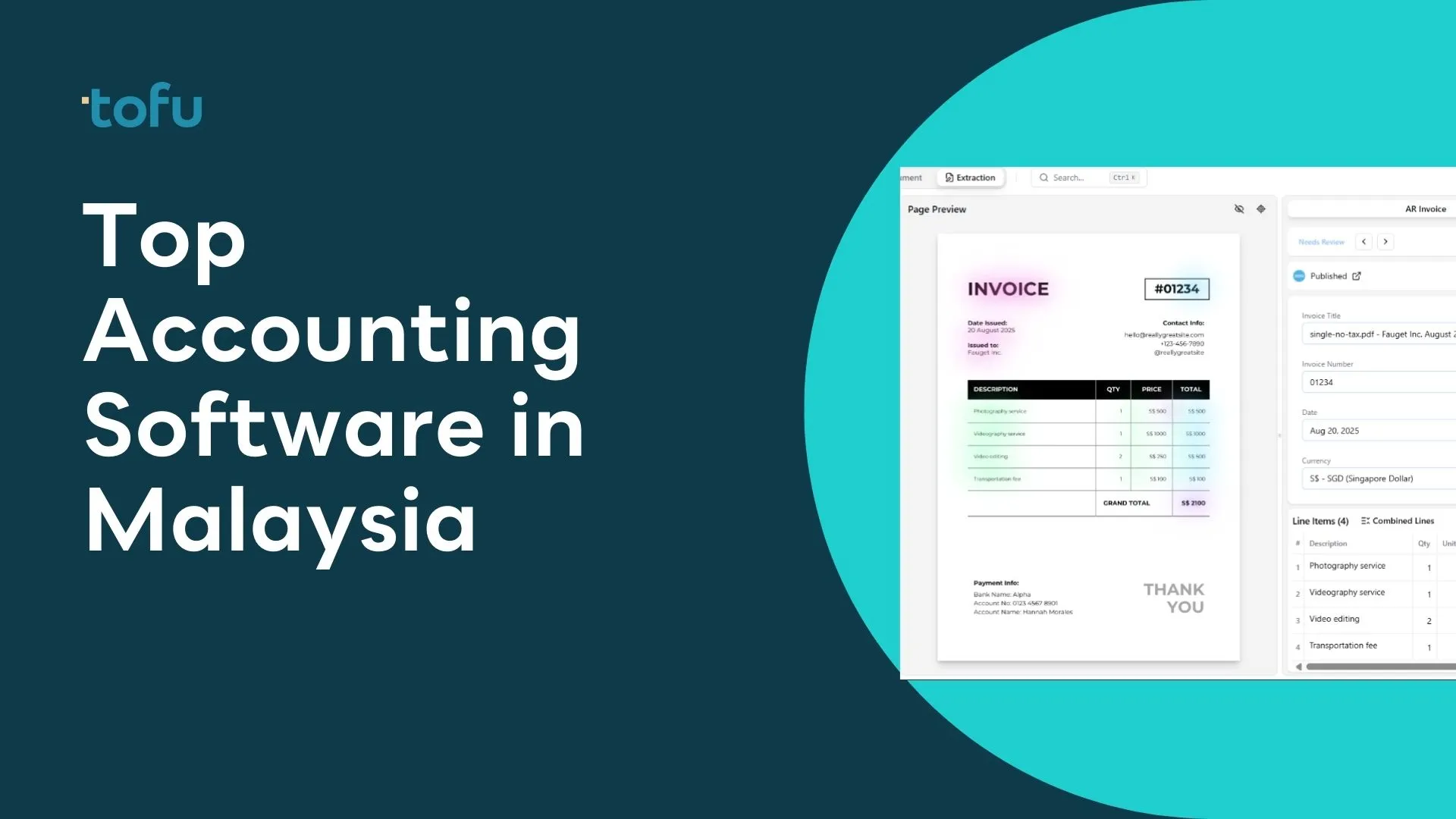
Top 12 Accounting Software in Malaysia for 2026

Top 12 Accounting Software in Malaysia. Discover the best accounting software in Malaysia for your business needs. Compare 12 top solutions with payroll and SST features.

Malaysian businesses face a defining moment in financial technology adoption. With LHDN's mandatory e-invoicing rollout extending to all businesses by 2026 and SST compliance remaining non-negotiable, selecting the right accounting software has become a strategic decision rather than an administrative one.

According to industry research, the accounting software market continues to expand as businesses seek automation solutions that handle local tax compliance, multi-currency transactions, and government reporting requirements specific to Malaysian regulations.

Quick Answer: Tofu stands out as the best bookkeeping automation software for Malaysian accounting firms in 2026, offering zero-configuration AI document processing that handles invoices in Bahasa Malaysia, Chinese, English, and 200+ other languages without manual rule setup. For firms processing high volumes of international supplier documents alongside local invoices, Tofu's line-by-line extraction and automatic Xero/QuickBooks integration delivers accuracy that traditional OCR tools cannot match.

What is Bookkeeping Automation Software?

Bookkeeping automation software represents a fundamental shift in how accounting professionals handle financial data. Rather than manually entering every invoice, receipt, and bank transaction, modern automation tools use artificial intelligence to read documents, extract relevant information, and post entries directly to accounting systems.

Traditional bookkeeping required accountants to spend hours each day on repetitive data entry. Invoice amounts, vendor details, tax calculations, and payment terms all needed manual input - a process prone to errors and exhausting for staff. Modern automation software eliminates this bottleneck by processing documents automatically while maintaining the accuracy required for regulatory compliance.

The technology addresses several persistent challenges that Malaysian businesses face. SST calculations must align precisely with Royal Malaysian Customs Department requirements. E-invoicing mandates from LHDN require specific data formats and validation. Multi-currency transactions with suppliers across ASEAN, China, and beyond need accurate processing. Bahasa Malaysia and Chinese language documents require extraction capabilities that many Western-focused tools lack.

For accounting firms serving diverse clients across Malaysia, automation software transforms the economics of bookkeeping services. Instead of dedicating staff to data entry, firms can focus on advisory services, tax planning, and client relationships. The software handles repetitive work while accountants apply their expertise where it matters most.

The evolution from basic OCR (optical character recognition) to AI-powered extraction marks a significant advancement. Early tools could digitize text but required extensive rule configuration for each document type and format. Current solutions like Tofu use machine learning to understand document context, extracting line items, tax amounts, and vendor details without pre-programmed rules. This zero-configuration approach proves essential for firms handling documents from hundreds of different suppliers and clients.

How to Choose Accounting Software for Your Business?

Selecting the right accounting software requires evaluating several factors specific to Malaysian operations. The wrong choice leads to compliance issues during LHDN audits, wasted implementation costs, and ongoing frustration with manual workarounds.

SST Compliance Capabilities

Any accounting software used in Malaysia must handle Sales and Service Tax calculations accurately. Since March 2024, service tax increased from 6% to 8% for most taxable services, with certain industries having both 6% and 8% rates depending on specific goods and services. Look for software that automatically applies correct SST rates, tracks input and output tax, and generates SST-02, SST-02A, and related forms required by RMCD. Poor SST handling creates audit risks and potential penalties.

LHDN E-Invoicing Readiness

Malaysia's mandatory e-invoicing rollout represents the most significant compliance change in years. Phase 1 began in August 2024 for large taxpayers, with all businesses required to comply by phased dates through 2026. Ensure your accounting software connects with LHDN's MyInvois system, validates invoices against required formats, and handles both standard and self-billed e-invoice types. Some platforms offer this natively while others require third-party add-ons.

Multi-Language Document Processing

Malaysian businesses routinely handle documents in Bahasa Malaysia, English, Chinese (Traditional and Simplified), and Tamil. The software should process documents in all relevant languages accurately. For document automation tools like Tofu, this goes beyond interface translation - the system needs to extract data correctly from invoices regardless of language.

Multi-Currency Support

Trade with Singapore, China, Indonesia, Thailand, and global partners means handling multiple currencies daily. The software should manage real-time exchange rate updates, automatic currency conversions, and consolidated reporting across currencies. Look for Bank Negara Malaysia exchange rate integration where available.

Local Bank Connectivity

Bank feed integration saves significant time on reconciliation. Verify whether the software connects with major Malaysian banks including Maybank, CIMB, Public Bank, RHB, and Hong Leong. SQL Account, for example, offers auto-reconciliation with over 20 Malaysian banks through AI matching.

Scalability and Pricing Model

Per-user pricing becomes expensive as teams grow. Entity-based or unlimited-user pricing models offer better value for multi-user environments. Consider not just current needs but growth projections over the next few years. Also evaluate whether you need cloud access, desktop stability, or hybrid deployment options.

Local Support Availability

When issues arise - especially during SST filing periods or e-invoicing deadlines - access to local support in Malaysian timezones and languages makes resolution faster. Some international platforms lack dedicated Malaysia support, leading to delayed responses during critical periods.

Integration Requirements

The software should connect with existing systems - e-commerce platforms, POS systems, payroll software, and any ERP platforms already in use. For accounting firms, integration with document processing tools like Tofu enables automated data extraction from client documents directly into the general ledger.

Quick Comparison Table

Tool Best For Starting Price SST Ready E-Invoice Ready
Tofu AI document processing $79/month Via Xero/QBO Via Xero/QBO
SQL Account Trading businesses RM1,499+ Yes Yes
AutoCount SME all-rounder ~RM20/month Yes Yes
Bukku Free e-invoicing Free tier available Yes Yes
Xero Cloud-first teams ~RM120/month Yes Via partners
UBS (Access UBS) Established SMEs Contact dealer Yes Yes
MYOB Inventory management From RM5.50/month Yes Limited
Sage Enterprise needs Contact dealer Yes Yes
QuickBooks Online Global recognition ~RM65/month Yes Limited
SAP Business One Large enterprises Custom pricing Yes Yes
Tally Desktop users Contact dealer Manual setup Manual setup
QNE Cloud AI-powered SME Contact dealer Yes Yes

The 12 Best Accounting Software for Malaysia in 2026

1. Tofu - Best for AI-Powered Document Processing

Tofu transforms how accounting firms handle document processing with zero-configuration AI that eliminates the rule setup that frustrates users of traditional tools. For Malaysian businesses processing invoices in Bahasa Malaysia, Chinese, English, and documents from international suppliers across ASEAN, Tofu delivers accuracy that manual entry and legacy OCR cannot match.

The platform's standout feature is its ability to extract line-by-line detail from invoices - not just totals. While competitors like HubDoc capture only header information and amounts, Tofu reads every line item, capturing descriptions, quantities, unit prices, and tax breakdowns. This level of detail proves essential for businesses tracking inventory costs, managing project expenses, or requiring detailed expense categorization for clients.

Key Features

Tofu processes documents in over 200 languages without configuration changes. Upload a Chinese fapiao from a Guangzhou supplier, an invoice in Bahasa Malaysia, a Thai receipt, or a handwritten note - the AI adapts automatically. This capability matters significantly for Malaysia's diverse business environment where suppliers and clients span multiple countries and languages.

The automatic PDF splitting feature handles bulk uploads intelligently. Upload a 50-page bank statement or a stack of scanned invoices from a client, and Tofu separates them into individual documents, processes each one, and posts the data to Xero or QuickBooks Online. No manual splitting or page-by-page processing required - a significant time-saver for firms handling multiple client accounts.

Integration with Xero and QuickBooks Online ensures extracted data flows directly into accounting systems. The platform maps vendor details, line items, tax amounts, and payment terms automatically. Accountants review and approve rather than re-enter, shifting their role from data entry to quality control.

Handwritten document processing sets Tofu apart from competitors that struggle with anything beyond typed text. Construction sites, retail environments, wet markets, and field operations often generate handwritten receipts that other tools simply reject. Tofu handles these without special configuration.

Pricing

Tofu uses entity-based pricing that eliminates per-user fees:

  • Starter: $79/month (approximately RM350) - ideal for small practices
  • Growth: $199/month (approximately RM880) - for firms with higher volume

This pricing model delivers significant value compared to per-user alternatives that charge for each team member accessing the system. A firm with five accountants processing documents pays the same as a solo practitioner.

Pros

  • Zero configuration required for new document types
  • 200+ language support including Bahasa Malaysia, Chinese, and English
  • Line-by-line extraction, not just totals
  • Automatic PDF splitting for bulk processing
  • Entity-based pricing without per-user fees
  • Handwritten document processing
  • Direct Xero and QuickBooks integration

Cons

  • Focused on document processing rather than full accounting
  • Requires Xero or QuickBooks as the general ledger
  • SST and e-invoicing handled by the connected accounting platform

Best For

Tofu is ideal for accounting firms and bookkeepers in Malaysia who process high volumes of documents from diverse sources and want to eliminate manual data entry. Firms serving clients with international suppliers particularly benefit from the multilingual capabilities.

Customer Reviews

Tofu was named a Xero Global Emerging App of the Year Finalist in 2025, and the platform serves 7 of the Top 10 Global Accounting Networks including Baker Tilly, Deloitte, Mazars, BDO, and PKF. This enterprise adoption demonstrates the platform's reliability for high-volume professional use.

Try Tofu Free

2. SQL Account - Best for Trading and Distribution Businesses

SQL Account dominates the Malaysian market with over 600,000 accounting professionals and business owners using the platform. The software's deep integration with Malaysian compliance requirements - from SST to e-invoicing to payroll - makes it a natural choice for businesses wanting comprehensive local functionality.

Key Features

The platform delivers GST/SST certified accounting with automatic tax calculations and return generation. SST-02, SST-02A, and Laporan CJ(P) Jadual C-01 forms generate directly from the system. The e-Invoice module connects with LHDN's MyInvois for seamless submission and validation.

SQL Account's bank integration covers over 20 Malaysian banks with AI-powered auto-reconciliation. The system matches transactions intelligently, flagging discrepancies for review rather than requiring manual matching of every entry.

The WhatsApp integration stands out as uniquely useful - send quotations, invoices, and statements directly to clients via WhatsApp with a few clicks. CTOS integration provides real-time financial standing data on customers and suppliers for credit risk assessment.

Pricing

  • Starting price: RM1,499+ (lifetime license via MIA for members)
  • Standard pricing: RM1,599 to RM2,899 depending on supplier
  • Government SME Grant: 50% matching grant available for eligible businesses

SQL Cloud is available as an online alternative with subscription pricing.

Pros

  • Deep Malaysian compliance integration
  • Auto bank reconciliation with 20+ local banks
  • WhatsApp and CTOS integration
  • Government grant eligibility
  • Extensive local dealer network

Cons

  • Learning curve for new users
  • Desktop version requires local installation
  • Some features need additional modules

Best For

Trading and distribution businesses in Malaysia that need comprehensive inventory, billing, and compliance features with strong local support.

3. AutoCount - Best All-Rounder for Malaysian SMEs

AutoCount serves over 240,000 companies in Malaysia with accounting software that balances comprehensive features with ease of use. Both desktop and cloud versions ensure businesses can choose their preferred deployment model.

Key Features

The platform integrates accounting, inventory, sales, purchases, and billing in one system. LHDN e-Invoice compliance comes built-in with direct MyInvois submission and validation. SST handling includes automatic calculations and return generation.

AutoCount Cloud Accounting offers a pay-as-you-use model accessible from any device, while AutoCount Accounting 2.0 provides enterprise-grade desktop features with local API integration for custom development.

Pricing

  • Cloud: From approximately RM20/month
  • Desktop: Lifetime license options available
  • Promotional: Free 6-month Pro Plan with UOB Business Banking connection (worth RM1,080)

Pros

  • Both cloud and desktop options
  • Strong local compliance features
  • Reasonable pricing for SMEs
  • Good user interface
  • Extensive module options

Cons

  • Full features require multiple module purchases
  • Desktop version needs IT infrastructure

Best For

Malaysian SMEs wanting flexibility between cloud and desktop deployment with comprehensive accounting and inventory features.

4. Bukku - Best Free E-Invoicing Solution

Bukku offers Malaysian businesses a cloud-native accounting platform with genuinely free e-invoicing capabilities - a significant value proposition as LHDN mandates take effect. The platform's Peppol accreditation through MDEC enables seamless B2B e-invoice exchange.

Key Features

LHDN-compliant e-invoicing comes free on all plans, with both standard and self-billed invoice types supported. MyInvois submission happens with a button click, including batch submissions and consolidated e-invoice options.

The automated data entry feature accepts receipts and expense claims via WhatsApp upload. Bank statement reconciliation works through PDF upload with SmartRecon matching transactions automatically.

Pricing

  • Free Plan: Free invoicing forever for startups
  • Basic: For micro businesses
  • Intermediate: For fast-growing small businesses
  • Comprehensive: For established small businesses
  • Ultimate: For medium businesses
  • Bookkeeping services: From RM400/month

New pricing takes effect July 2025. Less than RM2/day for paid accounting features.

Pros

  • Free e-invoicing tier
  • Peppol network accredited
  • WhatsApp document upload
  • Automated bank reconciliation
  • Frequent feature updates

Cons

  • Newer entrant with smaller market share
  • Some features as paid add-ons
  • May lack depth for complex operations

Best For

Startups and small Malaysian businesses wanting free or low-cost e-invoicing compliance with modern cloud features.

5. Xero - Best for Cloud-First Teams

Xero brings global cloud accounting standards to Malaysian businesses with unlimited users on all plans. The platform's extensive integration ecosystem - over 800 apps - provides flexibility that locally-developed alternatives often lack.

Key Features

SST compliance includes automatic tax calculations with both 6% and 8% rates configurable for different service types. Bank reconciliation learns from past categorizations, speeding up the matching process over time.

The app marketplace extends functionality for Malaysian needs through certified partners. Tofu integrates directly with Xero for automated document processing, while other add-ons handle e-invoicing, payroll, and inventory.

Pricing

  • Starting: Approximately RM120/month
  • Add-ons: Multi-currency support +RM100/month, Project +RM30/user/month
  • Partner discounts: Available through certified partners like YYC (Platinum), CALTRiX (Gold), and Fusion ETA (Gold)

Pros

  • Unlimited users on all plans
  • Extensive integration ecosystem
  • Strong bank reconciliation
  • Global platform stability
  • Regular feature updates

Cons

  • E-invoicing requires partner solutions
  • Higher cost than local alternatives
  • Less localized support

Best For

Growing businesses with remote teams needing unlimited user access and extensive third-party integrations.

6. UBS (Access UBS) - Best for Established SMEs

UBS Evo brings 30 years of Malaysian market expertise with AI-enabled features for modern accounting needs. Trusted by over 500,000 SMEs, the platform combines local compliance depth with proven stability.

Key Features

AI-enabled features include a digital support assistant, collaborative tools, and learning resources built into the platform. LHDN e-invoicing integration validates invoices against required formats and submits through Evo Lite for approval.

SST handling generates all required forms including SST-02, SST-02A, and Jadual C-01. The mobile license feature enables remote access for up to 30 days without additional cloud subscription.

Pricing

Contact authorized dealers for pricing. First year of Access Cover subscription (upgrades and support) included free with new licenses.

Pros

  • Deep Malaysian market experience
  • AI-enabled modern features
  • Strong dealer support network
  • Proven reliability
  • Desktop with optional cloud hosting

Cons

  • Pricing requires dealer consultation
  • Primarily desktop-based
  • Less integrated than cloud-native options

Best For

Established Malaysian SMEs preferring desktop software with strong local support and proven track record.

7. MYOB - Best for Inventory-Heavy Businesses

MYOB has served Malaysian businesses since 1996, offering comprehensive accounting with particularly strong inventory management capabilities. The platform suits businesses where stock tracking is as important as financial reporting.

Key Features

Powerful inventory management tracks stock levels, handles multiple locations, and manages complex product hierarchies. Automatic double-entry posting eliminates manual journal entries for standard transactions.

The Business Insights feature provides current profit, turnover, and expense comparisons across financial periods. GST/SST compliance comes built-in with Malaysian Customs approval.

Pricing

  • Starting: From RM5.50/month for basic plans
  • Credit card fees: 1.8-2.2% per transaction
  • Bank transfers: Around RM1.50 per transfer

Pros

  • Strong inventory management
  • Long Malaysian market presence
  • User-friendly interface
  • Affordable entry point

Cons

  • E-invoicing support limited
  • SST updates may lag
  • Support response varies

Best For

Product-based businesses requiring strong inventory tracking alongside standard accounting features.

8. Sage - Best for Growing Enterprises

Sage provides enterprise-grade accounting capabilities for Malaysian businesses scaling beyond basic SME needs. The platform's depth suits companies with complex multi-entity structures, advanced reporting requirements, or international operations.

Key Features

Advanced modules cover fixed assets, job costing, multi-department management, and sophisticated budgeting. The platform handles multi-currency transactions with automatic exchange rate updates.

Malaysian compliance features include SST handling and integration capabilities for e-invoicing requirements.

Pricing

Contact Sage Malaysia or authorized dealers for pricing. Enterprise features command premium pricing reflecting the platform's depth.

Pros

  • Enterprise-grade capabilities
  • Strong reporting features
  • Scalable architecture
  • Multi-entity support

Cons

  • Higher cost than SME alternatives
  • Implementation complexity
  • May be overkill for smaller businesses

Best For

Growing enterprises needing advanced accounting features beyond basic SME requirements.

9. QuickBooks Online - Best for Global Brand Recognition

QuickBooks brings familiar accounting workflows to Malaysian businesses with features adapted for local requirements. The platform's global reputation and extensive third-party ecosystem make it comfortable for businesses with international connections.

Key Features

Standard accounting functions include invoicing, expense tracking, bank reconciliation, and financial reporting. SST configuration requires manual setup but handles Malaysian tax requirements once configured.

The app marketplace extends functionality through integrations including Tofu for automated document processing, payment gateways, and inventory management tools.

Pricing

Starting around RM65/month with various plan tiers. 30-day free trial available.

Pros

  • Familiar interface globally
  • Extensive integration ecosystem
  • Cloud-based accessibility
  • Strong mobile apps

Cons

  • E-invoicing requires workarounds
  • SST needs manual configuration
  • Per-user pricing increases costs

Best For

Businesses familiar with QuickBooks from other markets or those needing extensive third-party integrations.

10. SAP Business One - Best for Large Enterprises

SAP Business One delivers enterprise resource planning capabilities that extend far beyond accounting. Large Malaysian corporations with complex operations find the platform's depth appropriate for their multi-faceted needs.

Key Features

Complete ERP functionality covers accounting, sales, purchasing, inventory, production, and service management. Multi-subsidiary support consolidates data across entities, currencies, and jurisdictions.

Malaysian localization includes SST compliance and e-invoicing capabilities through partner implementations.

Pricing

Custom pricing based on modules, users, and implementation scope. Expect significant investment for full deployment.

Pros

  • Complete ERP solution
  • Multi-entity consolidation
  • Global compliance support
  • Extensive customization

Cons

  • High cost of ownership
  • Complex implementation
  • Requires partner expertise

Best For

Large enterprises with complex operational requirements needing integrated ERP beyond standalone accounting.

11. Tally - Best for Desktop Traditionalists

Tally serves businesses preferring traditional desktop accounting with strong offline capabilities. Popular across Asia, the platform offers comprehensive features without requiring internet connectivity.

Key Features

Complete accounting modules handle ledgers, receivables, payables, and inventory in an integrated environment. Multi-currency support manages international transactions.

Malaysian compliance requires configuration for SST handling. E-invoicing integration needs third-party solutions or manual processes.

Pricing

Contact Tally dealers in Malaysia for current pricing. Lifetime license options available.

Pros

  • Proven desktop reliability
  • Strong offline operation
  • Comprehensive features
  • Wide Asian market presence

Cons

  • Limited cloud capabilities
  • E-invoicing not native
  • SST requires configuration

Best For

Businesses with unreliable internet connectivity or strong preference for traditional desktop software.

12. QNE Cloud (N3 AI Cloud Accounting) - Best AI-Native Platform

QNE AI Cloud Accounting represents Malaysia's home-grown response to modern accounting needs, combining LHDN compliance, AI automation, and SME-focused pricing in a cloud-native platform.

Key Features

AI-driven automation handles routine bookkeeping tasks with minimal configuration. LHDN e-invoicing compliance comes built-in with seamless MyInvois integration. SST and local reporting formats follow Malaysian requirements natively.

The platform's Malaysian development means local regulations receive priority attention rather than being afterthoughts to global features.

Pricing

Contact QNE for current pricing. Designed for SME affordability.

Pros

  • Malaysian-developed
  • AI automation features
  • Native LHDN compliance
  • Cloud-first architecture

Cons

  • Newer platform
  • Smaller integration ecosystem
  • Limited international presence

Best For

Malaysian SMEs wanting local cloud accounting with AI features and native LHDN compliance.

Feature Comparison: All 12 Tools

Feature Tofu SQL Account AutoCount Bukku Xero UBS MYOB Sage QuickBooks SAP Tally QNE
SST Ready Via GL Native Native Native Yes Native Yes Yes Manual Yes Manual Native
E-Invoice Via GL Native Native Native Partner Native Limited Yes Limited Yes Manual Native
Cloud Option Yes Yes Yes Yes Yes Yes Yes Yes Yes Yes Limited Yes
Multi-Language Doc 200+ Limited Limited Limited Limited Limited Limited Limited Limited Yes Limited Limited
Line-Item Extract Yes No No No No No No No No No No No
Unlimited Users Entity Per-license Varies Varies Yes Per-license Per-user Per-user Per-user Per-user Per-license Varies
Local Bank Feeds Via GL 20+ banks Yes Yes Limited Yes Yes Yes Limited Yes Limited Yes
Inventory Via GL Yes Yes Yes Limited Yes Yes Yes Yes Yes Yes Yes

Pricing Comparison

Tool Entry Price Mid-Tier Notes
Tofu $79/month $199/month Entity-based, no per-user
SQL Account RM1,499+ RM2,899+ Lifetime license options
AutoCount ~RM20/month Custom Cloud and desktop options
Bukku Free <RM2/day Free e-invoicing tier
Xero ~RM120/month +add-ons Per-organization
UBS Contact dealer Contact dealer Dealer pricing
MYOB RM5.50/month Custom Transaction fees apply
Sage Contact dealer Contact dealer Enterprise pricing
QuickBooks ~RM65/month Higher tiers Per-user pricing
SAP Custom Custom Enterprise investment
Tally Contact dealer Contact dealer Lifetime license
QNE Contact dealer Contact dealer SME-focused

LHDN E-Invoicing Compliance Guide

Understanding Malaysia's e-invoicing requirements helps inform software selection. Here's what businesses need to know:

Implementation Timeline:

  • Phase 1 (August 2024): Taxpayers with annual turnover >RM100 million
  • Phase 2 (January 2025): Taxpayers with annual turnover >RM25 million
  • Phase 3 (July 2025): All remaining taxpayers

Required Capabilities:

  • MyInvois portal integration for e-invoice submission
  • Validation of invoice data against LHDN requirements
  • Support for both standard e-invoices and self-billed e-invoices
  • Consolidated e-invoice submission for eligible transactions
  • QR code generation on validated e-invoices

Software Readiness:

Native e-invoicing is built into SQL Account, AutoCount, Bukku, UBS, and QNE. Xero and QuickBooks users typically need certified partner solutions or third-party integrations. Tofu users benefit from e-invoicing capabilities in their connected Xero or QuickBooks platform.

Migration and Implementation Considerations

Switching accounting software or implementing a new system requires careful planning. Consider these factors:

Data Migration:

  • Export chart of accounts, customer/supplier lists, and opening balances
  • Verify historical transaction compatibility
  • Plan cut-over timing around SST filing periods
  • Allow parallel operation period for validation

Training Requirements:

  • SQL Account and AutoCount have extensive local training resources
  • Xero certified partners offer implementation support
  • Tofu requires minimal training due to zero-configuration design

Integration Setup:

  • Bank feed connections need authorization from financial institutions
  • E-commerce integrations require API configuration
  • Document automation tools like Tofu connect via standard Xero/QuickBooks APIs

How to Choose the Right Accounting Software

Choose Tofu if you:

  • Process high volumes of invoices and receipts from diverse sources
  • Handle documents in multiple languages including Chinese and Bahasa Malaysia
  • Want to eliminate manual data entry completely
  • Already use Xero or QuickBooks as your general ledger
  • Need line-by-line extraction, not just invoice totals
  • Serve clients with international suppliers across ASEAN and beyond

Book a Demo with Tofu

Choose SQL Account if you:

  • Operate a trading or distribution business
  • Need deep Malaysian compliance features
  • Want WhatsApp integration for client communications
  • Prefer lifetime licensing over subscriptions
  • Value extensive local dealer support

Choose AutoCount if you:

  • Want flexibility between cloud and desktop
  • Need comprehensive inventory alongside accounting
  • Prefer established Malaysian software with modern features
  • Have moderate budget constraints

Choose Bukku if you:

  • Need free e-invoicing to start
  • Operate a startup or micro-business
  • Want modern cloud-native features
  • Prefer minimal upfront costs

Choose Xero if you:

  • Have multiple team members needing system access
  • Need extensive third-party integrations
  • Value unlimited users on all plans
  • Accept working with certified partners for localization

Choose UBS if you:

  • Prefer established software with proven track record
  • Need strong local dealer support
  • Want AI-enhanced desktop accounting
  • Value 30+ years of Malaysian market experience

Frequently Asked Questions

What is the most popular accounting software in Malaysia?

SQL Account and AutoCount lead the Malaysian market by user count, with SQL serving over 600,000 users and AutoCount over 240,000 companies. Both platforms offer deep local compliance features. For document processing automation, Tofu has gained traction among accounting firms seeking to eliminate manual data entry from diverse document sources.

What is the best free accounting software in Malaysia?

Bukku offers the most comprehensive free tier, including free e-invoicing capabilities compliant with LHDN requirements. Zoho Books provides a free tier for solopreneurs with basic features. For document automation, Tofu offers free trials to evaluate the platform before commitment.

Which accounting software supports LHDN e-invoicing?

SQL Account, AutoCount, Bukku, UBS, and QNE offer native LHDN e-invoicing integration. Xero and QuickBooks users can achieve compliance through certified partner solutions. SAP Business One handles e-invoicing through implementation partners. Tofu users benefit from e-invoicing in their connected accounting platform.

What is the best cloud accounting software in Malaysia?

Xero leads pure cloud accounting with unlimited users and extensive integrations. Bukku and QNE offer Malaysian-developed cloud alternatives. AutoCount Cloud Accounting provides cloud access with local compliance focus. For cloud-based document processing that feeds into cloud accounting, Tofu delivers zero-configuration automation across 200+ languages.

How much does accounting software cost in Malaysia?

Costs range from free (Bukku, limited features) to enterprise pricing (SAP). Most SME solutions cost between RM20-200/month for cloud options or RM1,500-3,000 for lifetime desktop licenses. Tofu starts at $79/month (approximately RM350) with entity-based pricing including unlimited users.

What accounting software handles SST automatically?

SQL Account, AutoCount, UBS, and MYOB handle SST calculations automatically with proper configuration. These platforms generate required RMCD forms including SST-02 and SST-02A. Xero handles SST with manual rate configuration. Tofu extracts tax amounts from documents accurately, with SST handling managed by the connected accounting platform.

Can accounting software process Chinese language invoices?

Most Malaysian accounting software handles Chinese interface options but limited Chinese document processing. Tofu excels here with AI-powered extraction from documents in Chinese (Traditional and Simplified), Bahasa Malaysia, English, and 200+ other languages - essential for businesses with suppliers in China, Taiwan, Hong Kong, and Singapore.

Conclusion

Selecting accounting software for Malaysian businesses requires balancing SST compliance, e-invoicing readiness, language support, and budget constraints. The right choice depends on specific operational requirements and growth plans.

For businesses struggling with manual data entry from diverse document sources - especially those handling invoices in multiple languages from international suppliers - Tofu eliminates the configuration headaches of traditional tools while delivering line-by-line accuracy across 200+ languages. The platform's entity-based pricing and direct Xero/QuickBooks integration make it an efficient addition to any accounting technology stack.

Firms seeking comprehensive local accounting find strong options in SQL Account for trading businesses, AutoCount for SME flexibility, or Bukku for free e-invoicing compliance. Desktop-preferring businesses continue to rely on UBS and Tally's proven capabilities.

The most effective approach often combines a solid general ledger platform with specialized automation tools. Pairing SQL Account, Xero, or QuickBooks with Tofu for document processing delivers both comprehensive accounting and AI-powered efficiency - essential as LHDN e-invoicing mandates increase the volume of digital documents flowing through Malaysian businesses.

Get Started with Tofu

Last updated: January 2026. All pricing and features verified as of publication date.

Latest blog posts

Stay up to date on new Tofu features, automation workflows, and the emerging tech shaping the future of bookkeeping.
View all
Guides

10 Best Multilingual Accounting Software 2026

A comprehensive comparison of the best multilingual accounting software for international businesses, featuring detailed analysis of language support, multi-currency capabilities, pricing, and global compliance features.
Saman Herath
January 23, 2026
Guides

Best AI Accounting Software & Tools for 2026: Top 10 AI Tools for Bookkeeping

A comprehensive comparison of the best AI bookkeeping software solutions for accounting firms and small businesses, with detailed analysis of features, pricing, and ideal use cases.
Saman Herath
January 20, 2026
Guides

Top 12 Accounting Software in Malaysia for 2026

Top 12 Accounting Software in Malaysia. Discover the best accounting software in Malaysia for your business needs. Compare 12 top solutions with payroll and SST features.
Saman Herath
January 16, 2026

Start Saving Hours Each Week With AI Bookkeeping

Discover how Tofu automates bookkeeping workflows from invoice to ledger. Schedule your demo today.