Saman Herath
January 15, 2026

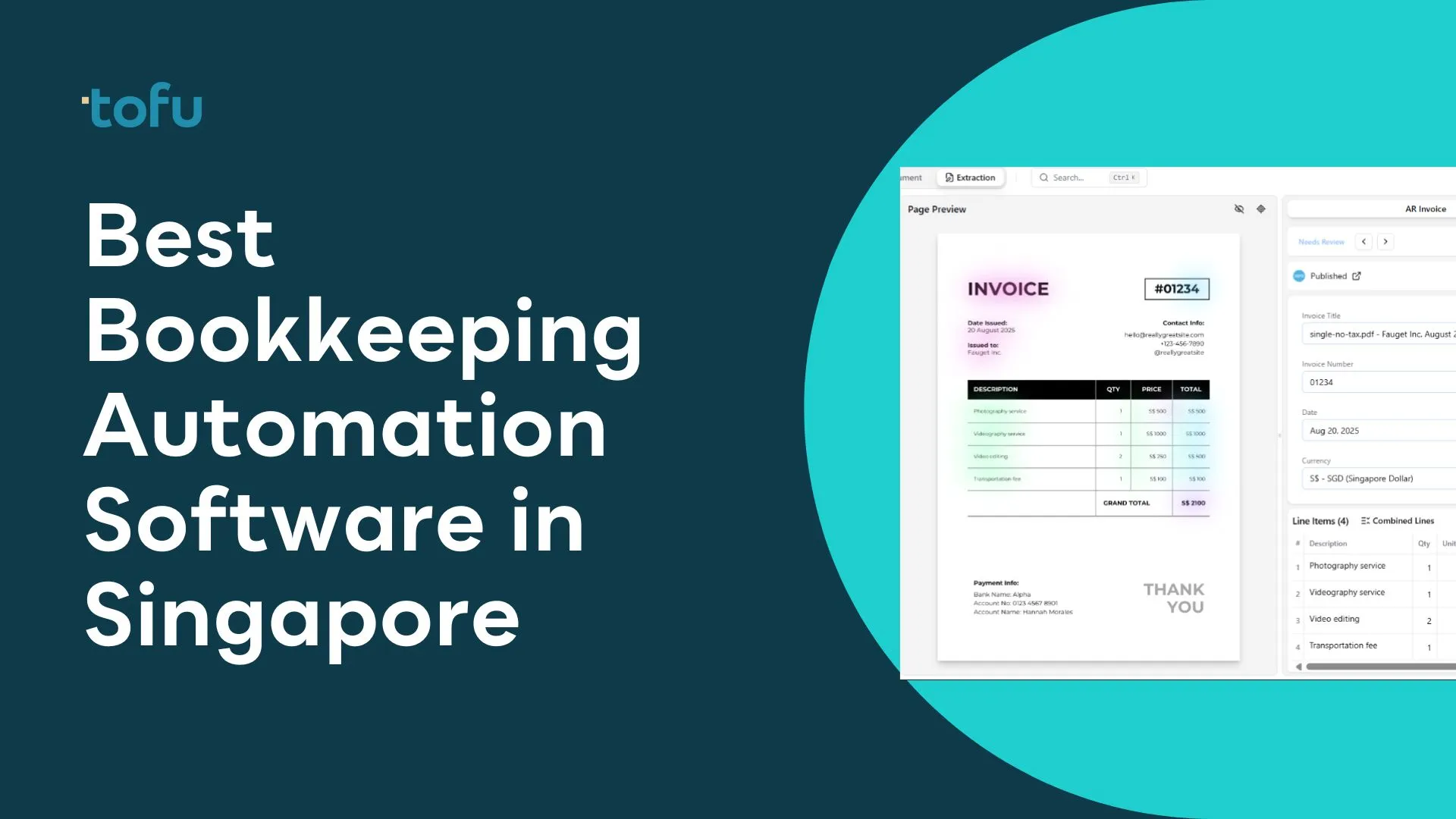
Singapore accounting firms face a unique challenge: processing documents in multiple languages while maintaining strict GST compliance with IRAS requirements. Manual data entry consumes 40-60% of billable hours, yet most bookkeeping automation tools were built for Western markets and struggle with Chinese invoices, handwritten receipts, and Southeast Asian document formats.
Quick Answer: Tofu is the best bookkeeping automation software for Singapore in 2026, offering zero-configuration AI that processes documents in 200+ languages, including Chinese fapiao and handwritten receipts, with native Xero integration and entity-based pricing that eliminates per-user fees.
This guide compares eight bookkeeping automation solutions available in Singapore, analyzing their features, pricing, GST compliance capabilities, and suitability for local accounting practices.
Bookkeeping automation software uses artificial intelligence and optical character recognition (OCR) to extract financial data from invoices, receipts, and bank statements, then automatically posts this information to accounting systems like Xero or QuickBooks. This technology eliminates the manual re-keying of supplier details, amounts, tax codes, and line items that traditionally consumed hours of bookkeeper time.
Modern bookkeeping automation goes beyond simple data capture. Advanced platforms now offer intelligent categorization, learning from previous transactions to automatically assign the correct nominal codes. They can split bulk PDF documents containing multiple invoices, reconcile supplier statements, and flag discrepancies before they become problems.
For Singapore businesses, bookkeeping automation must handle GST calculations correctly, support multi-currency transactions common in trade-dependent Singapore, and ideally process documents in both English and Chinese. The technology has evolved from basic OCR that struggled with non-standard formats to AI-powered systems achieving over 99% accuracy even on handwritten documents.
The shift to cloud-based bookkeeping automation has been particularly significant for Singapore SMEs, enabling real-time collaboration between business owners and their accountants. According to IRAS guidelines, businesses must maintain accurate records for at least five years, making automated document storage and retrieval increasingly valuable for compliance.
Selecting the right bookkeeping automation tool requires evaluating several factors specific to the Singapore market:
Language Support: Singapore businesses frequently receive invoices in English, Chinese (Simplified and Traditional), Malay, and Tamil. Many Western-built tools struggle with Chinese characters and non-Latin scripts. Look for platforms that explicitly support Asian languages and have been tested on local document formats.
GST Compliance: Your chosen software must correctly extract and categorize GST amounts for IRAS reporting. Verify that it handles the 9% GST rate and can distinguish between standard-rated, zero-rated, and exempt supplies.
Integration with Local Ecosystems: Most Singapore accounting firms use Xero, which dominates the local market, or QuickBooks Online. Ensure your automation tool offers native, two-way sync rather than basic CSV exports.
Document Processing Capabilities: Assess whether the platform handles line-item extraction or only captures invoice totals. For businesses with detailed purchase orders and inventory, line-by-line data extraction significantly reduces manual reconciliation.
Pricing Model: Singapore accounting firms typically manage multiple client entities. Per-user pricing becomes expensive quickly. Look for entity-based or volume-based pricing that scales with your practice without penalizing team growth.
Support and Time Zone: Consider whether customer support operates during Singapore business hours. Issues with document processing can halt client work, making responsive support essential.
Data Residency: Some Singapore businesses, particularly those in regulated industries, require data to remain within specific jurisdictions. Verify where your documents will be stored and processed.
Questions to ask vendors: Does your OCR work accurately on Chinese invoices? What happens when extraction fails - is there human review? How do you handle multi-page documents with several invoices in one PDF?
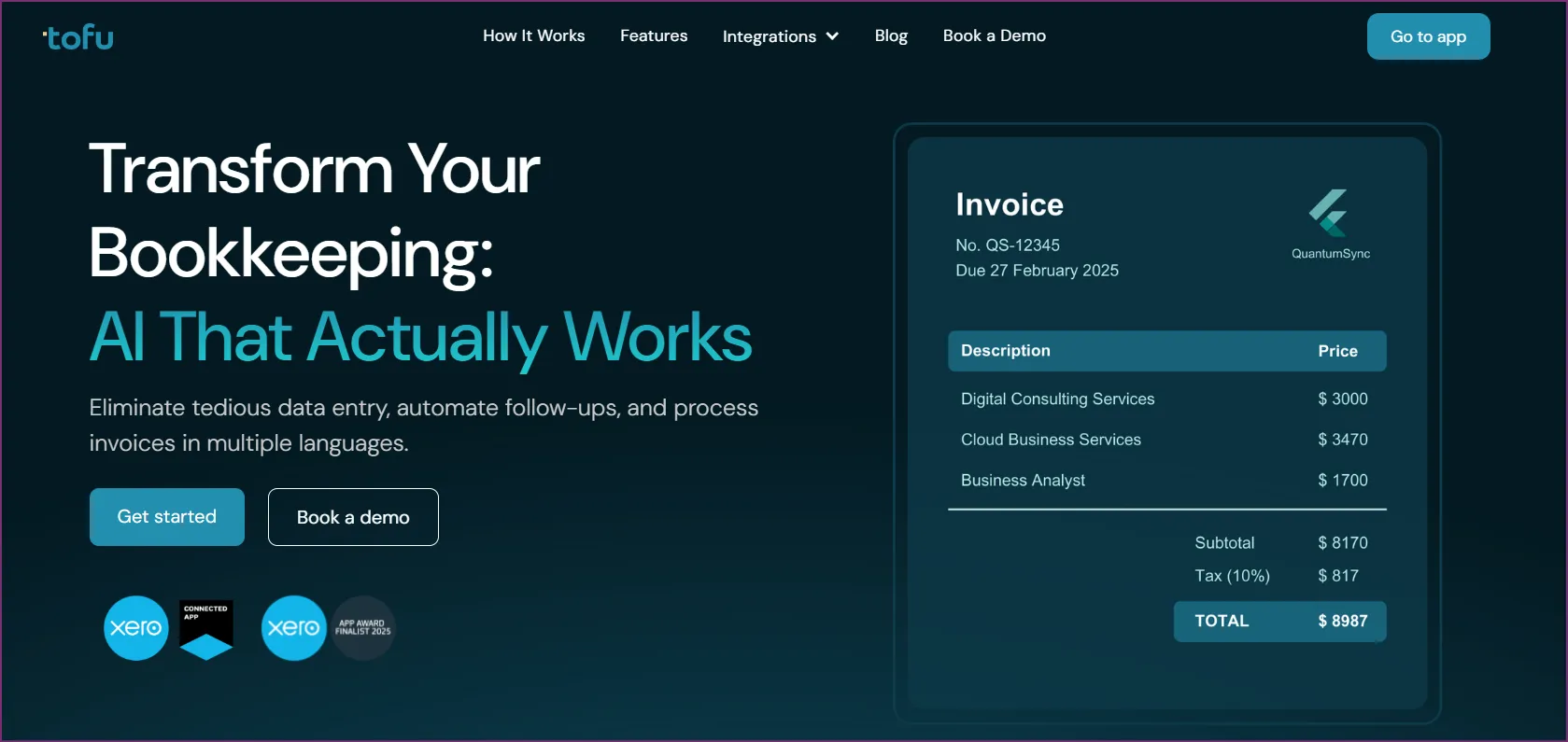
Tofu stands out as the leading bookkeeping automation solution for Singapore accounting firms, specifically engineered for the multilingual, document-heavy realities of APAC markets. Unlike competitors that retrofitted Western-built OCR for Asian languages, Tofu was designed from the ground up to handle Chinese fapiao, handwritten receipts, and the diverse document formats common across Southeast Asia.
The fundamental difference between Tofu and traditional automation tools lies in its zero-configuration setup. Most platforms require accountants to spend hours creating supplier rules, mapping fields, and training the system. Tofu eliminates this burden entirely through advanced AI that recognizes document structures automatically.
New accountants can upload documents and begin processing within minutes, not days. This matters enormously for Singapore practices onboarding new clients or handling seasonal workload spikes during GST filing periods.
Tofu processes documents in over 200 languages, including comprehensive support for Chinese (Simplified and Traditional), Japanese, Korean, Thai, Vietnamese, and Bahasa. For Singapore firms with clients who receive invoices from China, Taiwan, or regional suppliers, this capability eliminates the need for manual translation or secondary processing systems.
The platform handles handwritten documents with the same accuracy as printed ones, addressing a common pain point for retail and F&B clients who still receive handwritten receipts.
While competitors like HubDoc capture only invoice totals, Tofu extracts complete line-item details including descriptions, quantities, unit prices, and individual tax amounts. This granular extraction enables:
Singapore businesses commonly receive consolidated statements or bulk document packages from suppliers. Tofu automatically detects and splits multi-invoice PDFs into individual documents, each processed separately. This feature alone saves hours of manual document preparation each week for busy practices.
Tofu uses entity-based pricing that eliminates per-user fees:
This pricing model particularly benefits Singapore accounting firms that need multiple staff members accessing client documents without multiplying costs.
Singapore accounting firms processing documents in multiple languages, practices handling Chinese suppliers, and any firm tired of configuring rules for every new client. Particularly valuable for firms with high document volumes seeking predictable pricing.
Tofu was named Xero Global Emerging App of the Year Finalist 2025 and serves seven of the top ten global accounting networks, including Baker Tilly, BDO, and Mazars. This enterprise validation demonstrates reliability at scale.
Try Tofu Free | Book a Demo with Tofu
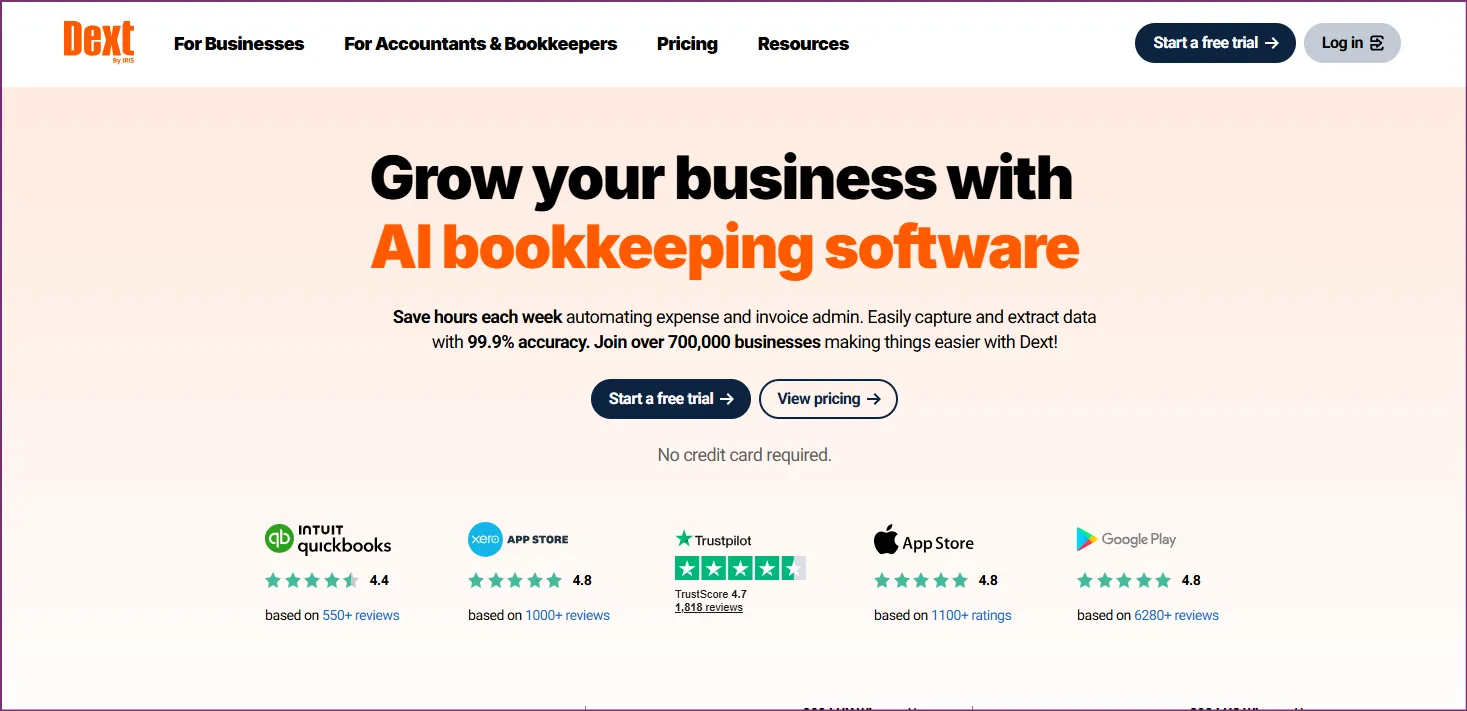
Dext (formerly Receipt Bank) is one of the longest-established document automation platforms, processing over 320 million documents annually through its global network of 700,000+ businesses and 12,000 accounting firms.
Dext offers comprehensive document capture through mobile apps, email forwarding, and direct uploads. Its supplier rules system allows detailed customization of how different vendors are processed, though this requires initial configuration time.
The platform connects to over 11,500 banks and integrates with more than 30 accounting software platforms. For established Singapore firms already invested in the Dext ecosystem, this breadth of integrations proves valuable.
Dext business plans start at US$31.50/month, scaling based on document volume and features. The platform uses a tiered model where costs increase with usage. Partner pricing for accounting firms involves per-client fees that can accumulate significantly for practices with many entities.
Large Singapore accounting firms with substantial budgets, primarily English-language document processing, and existing investment in the Dext ecosystem.
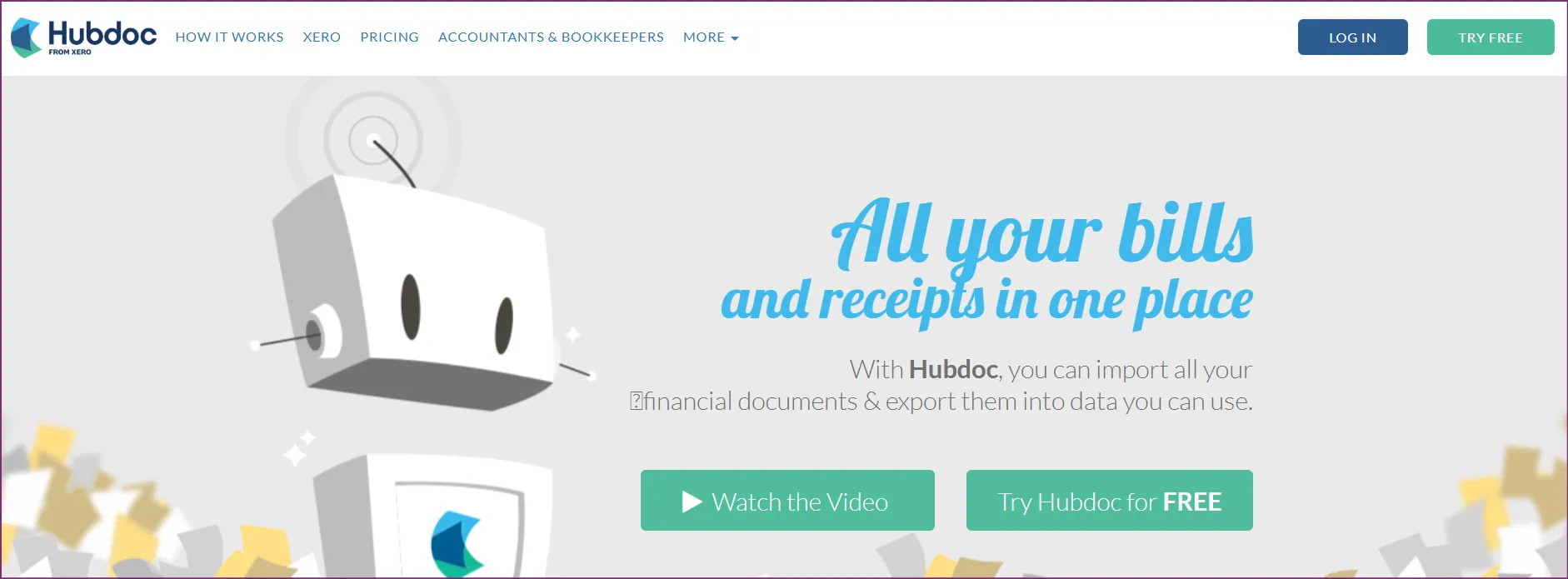
HubDoc, acquired by Xero in 2018, provides document capture functionality included free with all Xero subscriptions. For Singapore businesses already using Xero, HubDoc offers basic automation without additional costs.
HubDoc extracts supplier names, amounts, invoice numbers, and due dates from uploaded documents. It creates draft transactions in Xero with source documents attached, streamlining the bookkeeping workflow.
The platform supports multiple upload methods including mobile capture, email forwarding, and direct fetch from selected suppliers. Role-based access controls allow businesses to grant receipt upload permissions without exposing sensitive financial data.
Free with Xero Starter, Standard, and Premium plans. Xero pricing in Singapore starts from 33 SGD/month.
Small Singapore businesses using Xero who need basic receipt capture without additional costs, and who primarily process English-language documents.
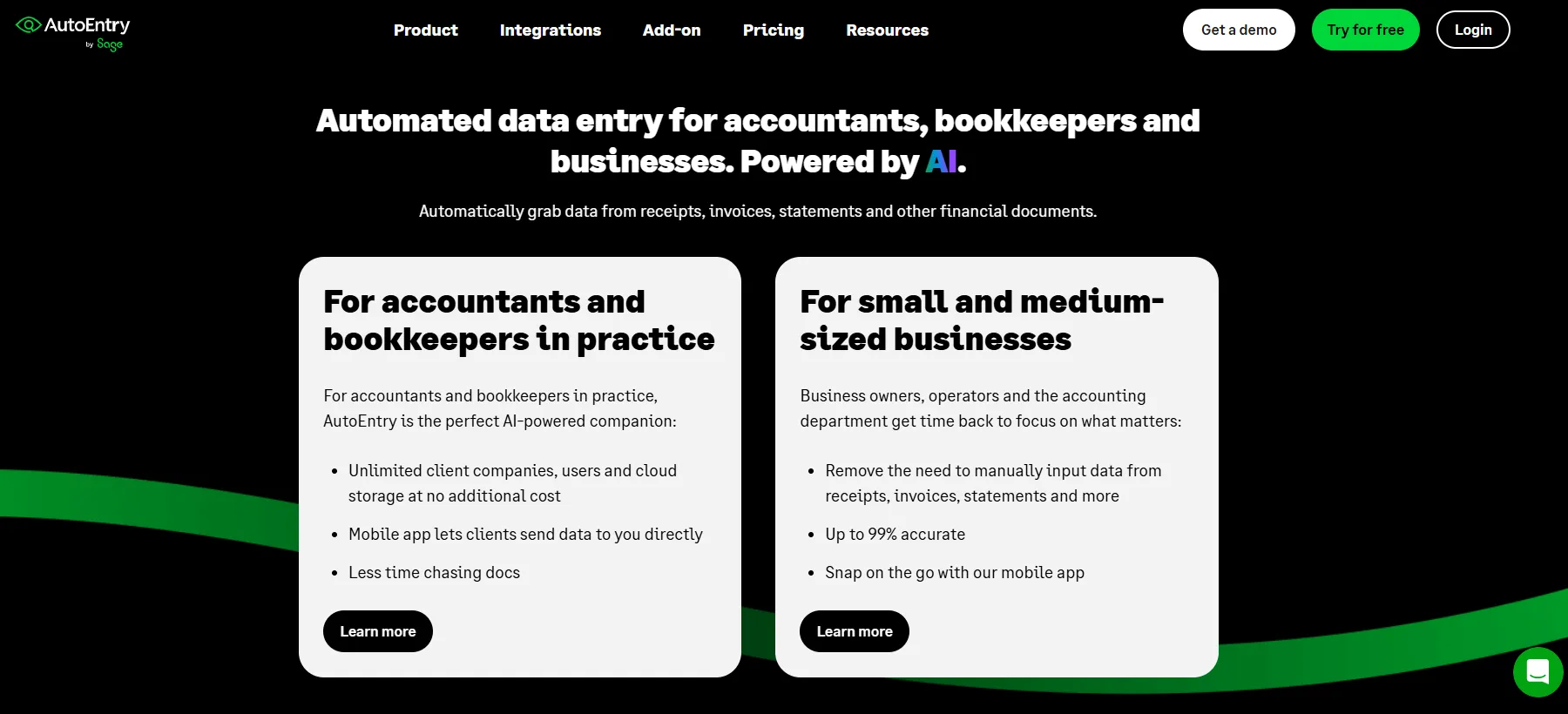
AutoEntry, recently acquired by Sage, offers a credit-based pricing model that appeals to firms preferring to pay only for actual usage. The platform extracts data from receipts, invoices, and statements with strong accuracy on English documents.
AutoEntry captures full line-item details including descriptions, quantities, and unit prices. The Smart Analysis feature remembers how users process invoices, automatically applying learned preferences to future documents.
Purchase order matching in QuickBooks and Xero streamlines approval workflows. The platform supports regular item auto-publishing, allowing routine invoices to flow through without manual intervention.
AutoEntry uses monthly credit subscriptions:
Credits carry forward monthly. Bank statement and line-item extraction consume more credits than basic invoice processing.
Singapore firms with variable document volumes who prefer usage-based pricing, primarily processing English-language invoices.
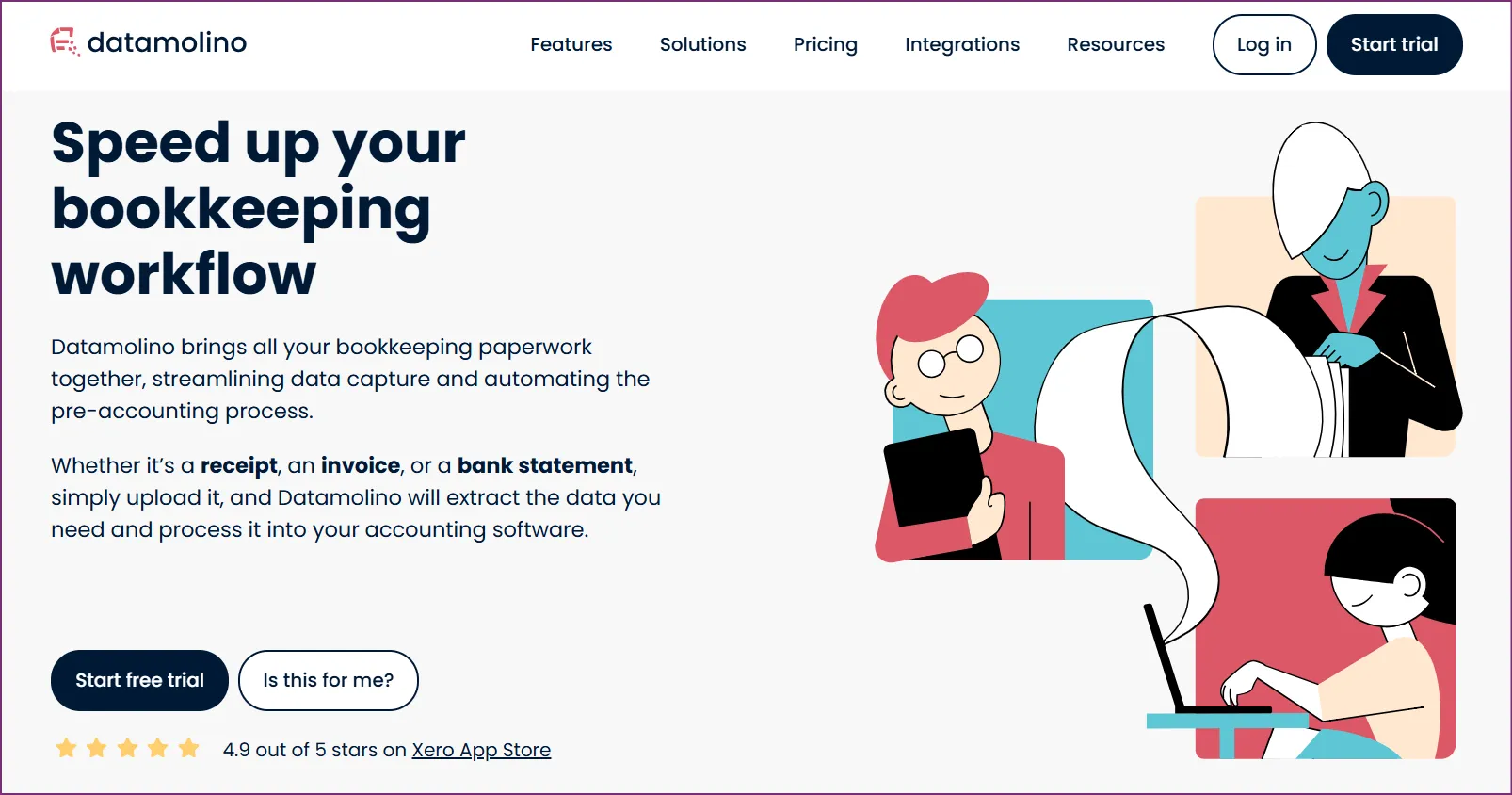
Datamolino provides straightforward invoice and receipt processing with a focus on simplicity and reliability. The platform achieves 99% extraction accuracy and integrates well with Xero and QuickBooks.
Datamolino captures vendor names, invoice numbers, line-item descriptions, quantities, and amounts using OCR technology. Bank statement conversion transforms PDF statements into clean CSV or Excel formats for direct export.
The platform offers collaboration features allowing clients to upload invoices directly. Unlimited users and clients are included in all plans.
Datamolino charges based on document volume:
All plans include unlimited users and clients.
Singapore accounting firms with straightforward English-language invoice processing needs who value simplicity over extensive features.
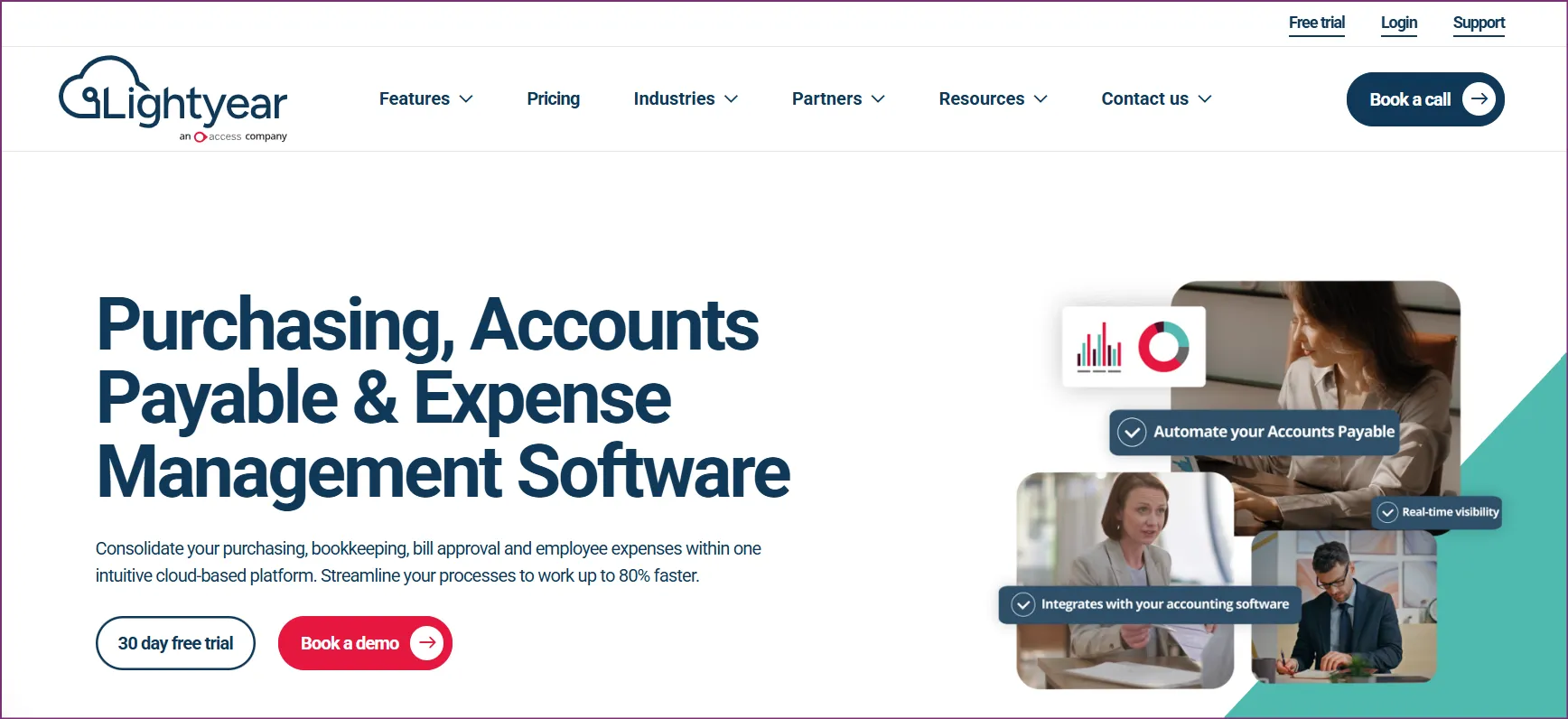
Lightyear targets medium to large enterprises needing comprehensive accounts payable automation, including purchase order creation, three-way matching, and multi-tier approval workflows.
The platform offers touchless line-item extraction using AI and machine learning. Purchase order management enables creation, approval, and sending from within the platform. Three-way matching automatically reconciles POs, deliveries, and invoices.
Multi-tier approval workflows support up to five levels, with mobile app access for on-the-go approvals. Fraud detection checks extracted bank details against stored records.
Pricing is credit-based with each document consuming one credit.
Larger Singapore businesses needing full accounts payable automation with purchase order management and approval workflows.
MYOB, operating as ABSS in Singapore, remains popular among businesses preferring desktop-installed accounting software. While not a pure automation tool, ABSS includes document management features alongside comprehensive accounting functionality.
ABSS offers English and Traditional Chinese interface support, making it suitable for Singapore's bilingual business environment. The software handles multi-currency transactions with automatic exchange difference calculations.
Project management, customer relationship management, and multi-location inventory features distinguish ABSS from pure bookkeeping tools. Multiple users can access data files concurrently with role-based permissions.
ABSS uses perpetual licensing (one-time purchase):
PSG Grant eligibility may provide up to 50% savings for qualifying Singapore businesses.
Singapore businesses preferring desktop software ownership, needing Chinese interface support, and eligible for PSG Grant subsidies.
Xero dominates the Singapore cloud accounting market and includes basic document capture features within its subscription. While not matching specialized automation tools, Xero's built-in capabilities suit businesses with modest document volumes.
Xero's inbox feature accepts emailed invoices and bills. Basic data extraction captures supplier details and amounts for draft bill creation. The platform is IRAS-certified for Singapore GST reporting.
Unlimited user access across all plans provides value for growing teams. The Xero App Store offers hundreds of add-ons including more powerful automation tools.
Singapore Xero pricing:
Small Singapore businesses with low document volumes who want basic capture without additional subscription costs.
For Singapore startups, Tofu combined with Xero provides the optimal combination of affordability and capability. Tofu's Starter plan at $79/month handles document automation with zero configuration, while Xero's Starter plan at 33 SGD/month manages GST-compliant accounting. This combination scales as the startup grows without requiring software changes.
Xero typically suits Singapore businesses better due to its IFRS compliance, unlimited user access, stronger local accountant community, and IRAS certification. QuickBooks offers advantages for businesses with US operations or needing advanced inventory features. Both integrate well with Tofu for document automation.
Modern bookkeeping automation tools like Tofu automatically extract GST amounts from invoices and categorize them correctly for IRAS reporting. Ensure your chosen tool supports Singapore's 9% GST rate and can distinguish between standard-rated, zero-rated, and exempt supplies. The extracted data flows to Xero or QuickBooks which generate IRAS-compliant GST reports.
Most Western-built automation tools struggle with Chinese characters. Tofu specifically supports Chinese (Simplified and Traditional), including Chinese fapiao format, with the same accuracy as English documents. This capability is essential for Singapore businesses sourcing from China or Taiwan.
HubDoc offers the lowest cost at free with any Xero subscription. However, for businesses needing more than basic capture, Tofu at $79/month provides significantly more capability including line-item extraction and multilingual support. The time savings typically exceed the subscription cost within the first month.
Traditional tools like Dext and AutoEntry require several hours to configure supplier rules and mappings. Tofu offers zero-configuration setup where users can begin processing documents immediately. Most firms achieve full productivity within the first day rather than the weeks required by rule-based systems.
Selecting the right bookkeeping automation software for Singapore requires balancing language support, GST compliance, integration capabilities, and pricing. While established Western platforms like Dext offer comprehensive features, they were not designed for the multilingual realities of Singapore business.
Tofu emerges as the clear leader for Singapore accounting firms and businesses, combining zero-configuration AI, 200+ language support including Chinese, line-by-line extraction, and entity-based pricing. These capabilities directly address the challenges unique to Singapore's diverse business environment.
For firms processing primarily English documents with existing Xero subscriptions, HubDoc provides a cost-free starting point. Those needing comprehensive AP automation beyond document capture should evaluate Lightyear's workflow capabilities.
The efficiency gains from proper bookkeeping automation typically deliver ROI within the first month through reduced manual entry time and improved accuracy. Singapore businesses competing in an increasingly digital economy cannot afford the productivity drain of manual document processing.
Get Started with Tofu | Book a Demo
Last updated: January 2026. All pricing and features verified as of publication date.