Jay Sen Lon
February 6, 2026

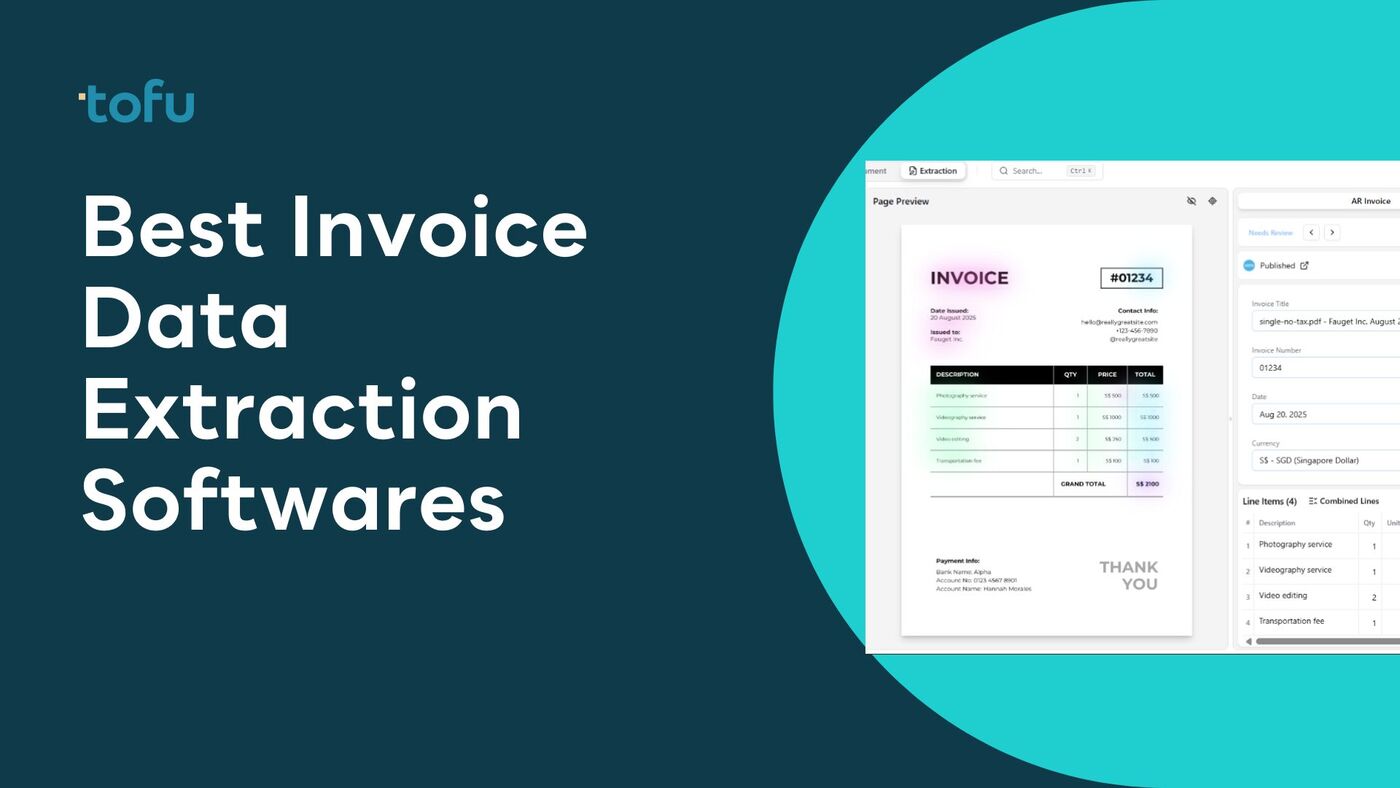
Invoice data extraction transforms unstructured documents into structured data ready for accounting systems. Manual invoice data entry costs accounting teams 40-70% of their billable hours while introducing 1-3% error rates that create downstream reconciliation problems.
This guide evaluates eight leading invoice data extraction software platforms based on extraction accuracy, line-item capabilities, language support, and implementation complexity. Whether your firm processes invoices for multiple clients or your business handles international suppliers across different currencies and languages, the right extraction platform can eliminate manual data entry entirely.
Quick Answer: Tofu leads the market for invoice data extraction with AI that processes invoices in 200+ languages and extracts complete line-item data including descriptions, quantities, unit prices, and taxes without configuration. Unlike traditional OCR requiring template setup for each invoice format, Tofu works immediately with handwritten documents, Chinese fapiao, and complex multi-page invoices.
Invoice data extraction software automates the process of converting invoice information from PDFs, scanned documents, emails, and images into structured digital data. These platforms employ optical character recognition (OCR) combined with artificial intelligence to identify invoice fields, understand document structure, and extract relevant information that feeds directly into accounting systems.
The technology has matured from basic OCR that simply converted images to text requiring human verification, to machine learning models that understand invoice context and extract data with minimal supervision. Modern AI-powered extraction platforms recognize patterns across millions of invoice variations, automatically identifying header information, line items, tax calculations, and payment terms regardless of invoice layout or supplier format.
The fundamental purpose is eliminating manual data entry while improving accuracy. Traditional invoice processing requires accountants to manually type invoice numbers, dates, amounts, supplier details, item descriptions, quantities, and tax information into accounting systems. This manual entry typically takes 5-10 minutes per invoice for simple documents and longer for complex multi-line invoices. Extraction software reduces this to under 1 minute of review time while cutting error rates by 80-90%.
For accounting firms serving multiple clients, invoice data extraction becomes mission-critical infrastructure. Firms processing thousands of invoices monthly across different industries, suppliers, and formats face scalability bottlenecks with manual entry. Solutions that require building templates or rules for each client and supplier create pre-processing overhead that limits growth. Modern AI extraction platforms eliminate this setup burden through contextual learning that adapts to new invoice formats automatically.
The business value extends beyond labor savings. Faster invoice processing enables early payment discounts worth 1-2% of invoice value. Reduced errors prevent payment disputes and maintain supplier relationships. Real-time visibility into payables helps businesses optimize cash flow. For accounting firms, automation allows the same team to serve more clients profitably without proportional staff increases, fundamentally changing firm economics.
Selecting invoice extraction software requires evaluating capabilities that directly impact ROI and operational efficiency.
Extraction depth and accuracy determine automation potential. Basic solutions extract only header information like invoice total, date, and supplier name, requiring manual line-item entry. Advanced platforms extract complete line-item data including descriptions, quantities, unit prices, tax amounts, and account codes. Test accuracy with your actual invoices, not vendor-provided samples. Expect 95%+ accuracy for standard formats and 90%+ for complex documents with quality platforms.
Language and script support becomes critical for international operations. Many extraction tools claim multi-language support but only work reliably with English and Western European languages. If your business processes Chinese invoices, Japanese receipts, Thai documents, or right-to-left scripts, verify actual performance with representative samples. Tofu handles 200+ languages including complex Asian character sets and mixed-language documents that traditional OCR struggles with.
Configuration requirements separate modern AI platforms from legacy OCR tools. Traditional solutions require building templates defining field locations for each invoice format. This setup takes hours per supplier and breaks when formats change. Template maintenance becomes ongoing overhead. Zero-configuration AI platforms learn document structures automatically, eliminating template building entirely. This matters enormously for accounting firms onboarding new clients or businesses with diverse supplier bases.
Document format handling determines versatility. Can the platform process PDFs, scanned images, photos from mobile devices, and email attachments? Does it handle handwritten invoices, faded documents, or invoices with stamps and annotations? Can it automatically split multi-invoice PDF files or process invoices embedded in email bodies? Tofu's automatic PDF splitting and handwritten document processing handle real-world complexity that many platforms can't.
Integration capabilities with your accounting ecosystem matter for end-to-end automation. Native connectors for Xero, QuickBooks, NetSuite, or your ERP ensure extracted data maps correctly to your chart of accounts and flows without manual export-import steps. API availability enables custom integrations with practice management systems, approval workflows, or proprietary platforms. Verify two-way sync capabilities for vendor records and tax codes.
Pricing model alignment with your usage pattern prevents cost surprises. Per-document pricing creates budget uncertainty for businesses with seasonal volume. Per-user pricing penalizes growing teams. Credit-based systems require monitoring consumption patterns. Entity-based pricing offers predictable costs regardless of user count or moderate volume fluctuations. Calculate total cost including implementation, training, and ongoing support.
Accuracy for your specific invoice types requires testing before committing. Different platforms excel with different document characteristics. Some handle typed invoices well but struggle with handwriting. Others work with English but fail on Asian languages. Many can't process supplier-specific formats like Chinese fapiao with their unique structure. Request pilot testing with your actual invoice mix rather than trusting generic accuracy claims.
Common pitfalls: Don't select based on marketing claims alone without hands-on testing. Avoid platforms requiring IT involvement for ongoing maintenance. Be cautious of vendors unwilling to demonstrate with your documents. Skip solutions locking you into proprietary formats preventing data portability if you need to switch providers.
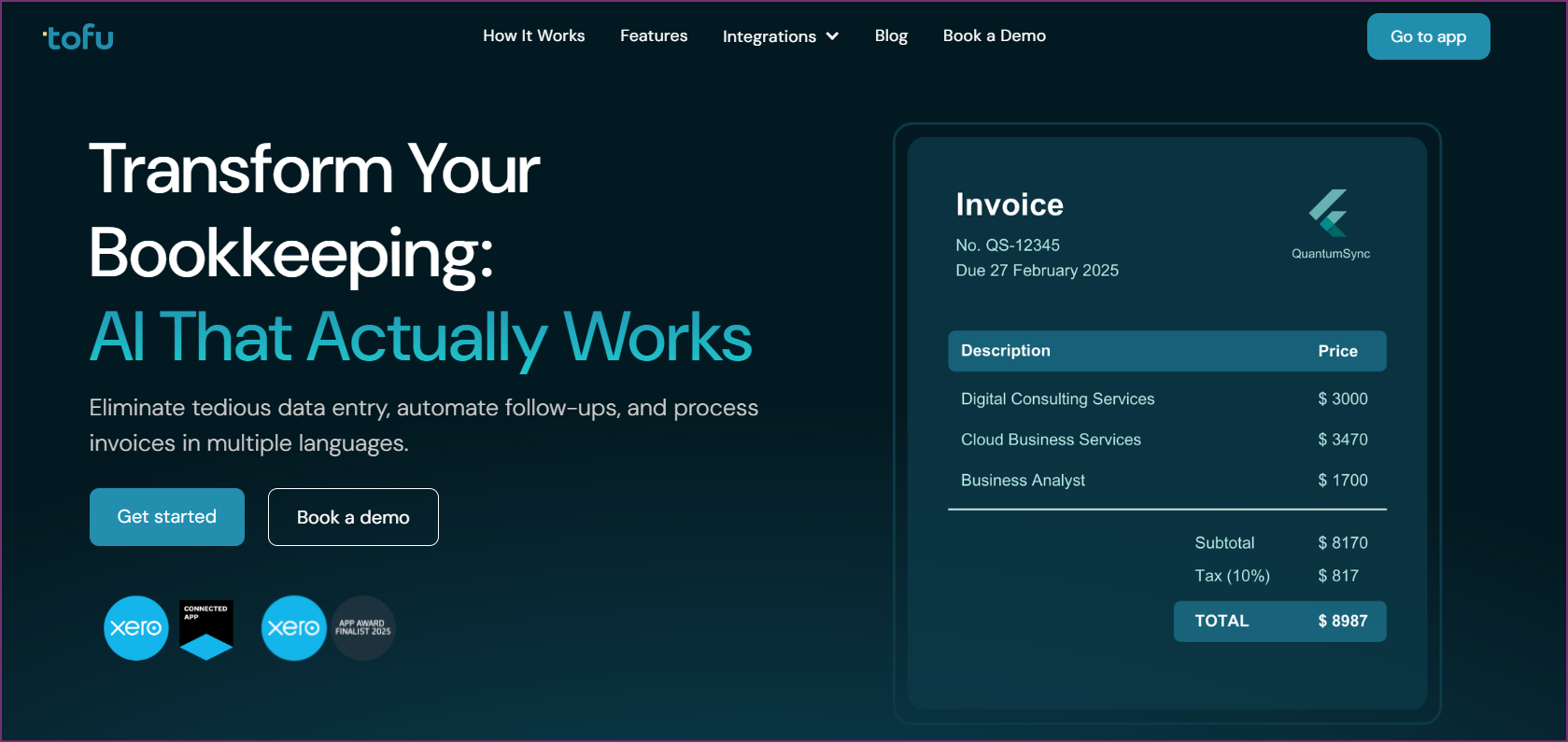
Tofu sets the standard for AI-powered invoice data extraction with zero-configuration processing that handles 200+ languages including complex Asian scripts traditional OCR can't process. Built specifically for accounting firms and businesses operating internationally, Tofu extracts complete line-item data from any invoice format without template building or rule configuration.
The platform's extraction accuracy stems from AI models trained on millions of international invoices rather than predominantly English documents. Tofu captures invoice headers (number, date, due date, supplier details, totals), complete line items (descriptions, quantities, unit prices, line totals, tax amounts), and contextual information (currency, payment terms, purchase order references) automatically. This comprehensive extraction enables straight-through processing for standard invoices and minimizes review time for complex documents.
Document format versatility handles real-world complexity. Tofu processes typed invoices, handwritten receipts, Chinese fapiao with mixed character sets, invoices with stamps and annotations, faded or poor-quality scans, mobile phone photos, and email attachments. Automatic PDF splitting separates multi-invoice files without manual intervention. This breadth eliminates the document type limitations that force businesses to maintain multiple extraction tools.
Zero-configuration setup takes minutes. Connect Tofu to your Xero or QuickBooks Online account, set basic preferences, and start processing invoices immediately. No template building for different suppliers. No rule configuration for invoice variations. No IT involvement for ongoing maintenance. This approach enables accounting firms to onboard new clients the same day without pre-processing setup that creates bottlenecks with traditional extraction platforms.
Multi-language capability extends beyond basic support to genuine accuracy with non-Western scripts. Tofu processes Chinese fapiao with their unique format requirements, Japanese receipts with mixed characters, Thai invoices with complex scripts, Vietnamese documents, Korean invoices, and Arabic text. Mixed-language invoices with English and local language content process accurately. This capability matters enormously for businesses operating in APAC markets or serving international clients.
Entity-based pricing charges per business entity rather than per user or document. Accounting firms serving 30 clients pay predictable monthly fees regardless of team size or invoice volume within plan limits. This pricing structure contrasts with per-user models that multiply costs as teams grow, or per-document pricing creating budget uncertainty during high-volume periods. The model scales efficiently for growing accounting practices.
Enterprise adoption validates reliability. Tofu serves seven of the world's Top 10 Global Accounting Networks including Baker Tilly, Mazars, BDO, and RSM for mission-critical invoice processing. Recognition as Xero Global Emerging App of the Year Finalist 2025 demonstrates innovation and customer impact. Maintained 5/5 stars on Xero App Store with feedback highlighting elimination of configuration overhead and accuracy with Asian language documents.
Regional compliance understanding extends beyond extraction to processing SST invoices for Malaysia, GST documentation for Singapore, VAT across jurisdictions, and e-invoicing formats mandated in different countries. This built-in regional knowledge reduces compliance risk compared to Western-centric tools adapted for international use.
Real-time processing dashboard provides visibility across all entities. Accounting firm partners monitor processing status for all clients from a single interface, identify bottlenecks, and track productivity metrics without switching between client files. This centralized oversight capability matters for firms managing dozens of client workflows simultaneously.
Tofu is the best choice for accounting firms processing invoices for multiple clients across regions, businesses handling international invoices in multiple languages, and organizations processing complex document types including handwritten receipts or Chinese fapiao. The platform excels for firms wanting to eliminate template configuration overhead entirely.
Growing accounting practices needing to onboard clients quickly without preprocessing delays benefit from zero-configuration setup. Businesses with distributed teams benefit from entity-based pricing that doesn't penalize adding users. Companies receiving bulk invoice files appreciate automatic PDF splitting.
Tofu maintains 5/5 stars on Xero App Store. Customers consistently highlight elimination of rule configuration, accuracy with Asian language documents, and predictable pricing as key advantages. Named Xero Global Emerging App of the Year Finalist 2025 for innovation in accounting automation.
Book a Demo with Tofu to test extraction accuracy with your specific invoice types.
Dext (formerly Receipt Bank) provides comprehensive document processing including invoice and receipt extraction, expense management, and financial document organization. The platform offers mobile receipt capture, bank feed reconciliation, and practice management integrations alongside extraction capabilities.
Configuration requirements exceed zero-configuration platforms but provide customization control. Setup involves building templates for invoice formats and configuring approval workflows. This investment pays off for stable supplier relationships but creates friction with format variations.
Dext's per-user pricing suits small teams but becomes expensive as headcount grows. Features include detailed analytics dashboards, multi-user collaboration tools, and extensive integration ecosystem with accounting and practice management platforms.
Language support focuses on Western European languages (English, French, German, Spanish) with limited Asian language accuracy. Businesses operating in Western markets find capabilities adequate while those with APAC operations need supplementary solutions.
Per-user pricing model (varies by region). Annual contracts typically required. Costs multiply with team growth.
Dext works best for Western-market businesses with stable teams, established supplier relationships, and standard invoice formats. Companies valuing extensive features and customization over simplicity may prefer this despite higher costs and configuration overhead.
HubDoc comes free with Xero subscriptions, making it attractive for Xero users wanting basic extraction without additional costs. The platform provides document capture and totals-only extraction sufficient for straightforward workflows.
The key limitation is extraction depth. HubDoc captures totals, dates, and vendor names but not line-item details. This approach works for simple approval workflows but limits automation for businesses needing detailed expense coding.
Development has slowed since Xero acquisition. The platform receives maintenance but few innovative features compared to actively developed alternatives. Language support remains primarily English. Automatic PDF splitting is absent.
Included free with Xero subscription.
HubDoc suits small businesses with simple needs, tight budgets, and straightforward workflows. If your Xero subscription includes HubDoc and requirements don't extend beyond totals extraction, it provides adequate functionality. Businesses needing line-item details or multi-language support should evaluate dedicated platforms.
AutoEntry uses credit-based pricing where documents consume credits by complexity. This provides flexibility for variable monthly volumes without paying for unused capacity.
The platform extracts line-item data and integrates with Xero, QuickBooks, and Sage. Setup requires some template configuration for optimal accuracy. Language support focuses on Western languages (English, French, German, Spanish) with limited Asian capability.
Credit system complexity requires monitoring. Simple invoices cost one credit while complex documents consume multiple credits. Budget forecasting requires understanding consumption patterns.
AutoEntry suits businesses with variable monthly volumes wanting usage-based pricing. Companies with seasonal fluctuations benefit from credit flexibility. Works best for Western-language documents.
Datamolino serves European small businesses with document-based pricing and European language support. The platform extracts line-item data and integrates with Xero, QuickBooks, and regional platforms.
Document-based pricing offers 100, 300, or 1,000 documents monthly with clear overage costs. Language support covers European languages comprehensively (English, German, French, Spanish, Italian, Dutch, Czech) but limits Asian processing.
Setup requires moderate configuration with templates for common formats.
Datamolino works for European small businesses and firms processing European-language invoices. Platform suits firms wanting transparent pricing and predictable volumes under 1,000 documents monthly.
BILL offers comprehensive AP automation beyond extraction, providing end-to-end workflow management including approval routing, payment execution, vendor management, and financial controls.
The platform targets US mid-market companies wanting centralized AP management. BILL handles full invoice-to-payment cycle: capture, approval, scheduling, payment via ACH or check, and reconciliation.
Pricing starts at $45/user/month. Implementation takes longer due to configuring approval hierarchies, payment methods, and vendor relationships. Language support focuses on English with limited international capabilities.
Per-user model plus payment transaction fees.
BILL works for US mid-market companies wanting full AP transformation rather than just extraction. Businesses processing primarily English-language domestic invoices benefit from comprehensive approach despite higher costs.
Lightyear targets fast-growing technology companies needing modern AP automation without enterprise complexity. The platform emphasizes user experience, speed, and seamless integration.
The solution provides comprehensive workflows including capture, approval routing, payment execution, and vendor communications. Implementation is fast with intuitive interface for non-accounting users.
Pricing starts at $169/month with core features and no per-user charges within reasonable team sizes. Language support focuses on English, adequate for US startups but limited globally.
Entity-based without per-user charges for typical teams.
Lightyear excels for venture-backed startups and tech companies needing comprehensive automation with minimal implementation time. Platform suits businesses where non-accounting staff handle workflows and user experience matters.
Spendesk provides comprehensive spend management including employee expense cards, approval workflows, budget controls, and invoice processing. The platform issues physical and virtual cards, enforces spending limits automatically, and integrates extraction with broader spend control.
Implementation is complex, requiring setup of card issuance, approval hierarchies, budget structures, and accounting integrations. Pricing follows custom quotes based on employee count and spending volume.
Platform suits businesses wanting centralized spend visibility across all company spending.
Custom pricing based on company size and requirements.
Spendesk suits medium to large businesses wanting complete spend management transformation. Organizations needing corporate cards, budget enforcement, and centralized visibility benefit despite complexity and cost.
Header extraction captures invoice-level information: invoice number, date, supplier name, total amount, and due date. Line-item extraction captures detailed information for each product or service: descriptions, quantities, unit prices, line totals, and tax amounts. Tofu provides complete line-item extraction enabling accurate expense coding to different accounts without manual entry.
Quality AI extraction platforms achieve 95%+ accuracy for standard invoices and 90%+ for complex documents, compared to 97-99% accuracy for manual entry but 10x faster processing time. The key difference: AI errors are systematic and easily caught during review, while manual entry errors are random and harder to detect. Tofu's accuracy with multi-language documents exceeds traditional OCR by 15-20 percentage points.
Capability varies dramatically. Traditional OCR trained on Western languages struggles with Chinese, Japanese, Korean, and Thai character sets. Tofu specifically handles 200+ languages including complex Asian scripts and mixed-language documents. Test with your actual document types during evaluation.
Zero-configuration extraction processes invoices immediately without building templates or defining rules. Tofu's AI learns document structures automatically, adapting to new formats without human intervention. Traditional OCR requires template setup for each invoice type taking hours per supplier.
Most platforms integrate with Xero, QuickBooks, NetSuite, and major ERPs. Tofu provides native Xero and QuickBooks integrations plus API access for custom connections. Integration depth varies from simple export to real-time sync with chart of accounts mapping.
Invoice data extraction software has evolved from template-based OCR to AI platforms that process documents automatically regardless of format. The right choice depends on language requirements, document complexity, and pricing model preferences.
Tofu leads the market through zero-configuration AI processing 200+ languages with complete line-item extraction, automatic PDF splitting, and entity-based pricing. The platform eliminates template configuration while handling document complexity traditional tools can't process.
For Western-market businesses with simple needs, alternatives like HubDoc (free with Xero), AutoEntry (flexible credits), or Datamolino (European focus) may suffice. Companies wanting full AP automation should evaluate BILL, Lightyear, or Spendesk based on workflow requirements.
Book a Demo with Tofu to test extraction accuracy with your specific invoice types.