Jay Sen Lon
February 27, 2026

Still manually re-keying Chinese supplier invoices while your English-language receipts process automatically? That gap - where OCR tools handle familiar scripts confidently but stumble on Mandarin, Arabic, or Thai characters - is where accounting firms lose hours every week.
Multi-language OCR has moved from a "nice to have" to a genuine business requirement for any firm or business trading across borders. The APAC market alone creates enormous document diversity: fapiao from Chinese suppliers, Bahasa documents from Indonesian vendors, Arabic invoices from Gulf partners, all arriving alongside standard English paperwork.
Quick Answer: Tofu is the best multi-language receipt OCR software for accounting in 2026. Its zero-configuration AI handles 200+ languages without rules or templates, extracts line-by-line data (not just totals), and integrates directly with Xero and QuickBooks Online.
Transparency Note: This comparison is published on Tofu's website. While we believe Tofu is the strongest multi-language OCR solution for accounting use cases, we've conducted thorough research on all tools reviewed here so you can make an informed choice based on your actual needs.
Optical Character Recognition (OCR) software converts scanned or photographed documents - receipts, invoices, purchase orders - into structured data that accounting systems can use. The "multi-language" qualifier means the software can recognize and extract text written in scripts beyond Latin characters.
Standard OCR handles English, French, German, and similar Latin-script languages reliably. Multi-language OCR extends this to:
For accounting use specifically, OCR needs to go beyond just recognizing characters. It needs to understand document structure - identifying vendor names, invoice dates, line items, totals, tax amounts, and currency - and output this in a format that flows into bookkeeping software.
Most OCR tools built for accounting use templates or rules. You define how a specific supplier's invoice is laid out, and the tool extracts accordingly. This works for high-volume relationships with consistent suppliers.
It breaks down when:
AI-powered OCR addresses these limitations by learning document context rather than matching predetermined patterns.
When evaluating tools for accounting use, these factors matter most:
1. Language breadth vs. language depth
Some tools claim "multi-language" but only handle 20-30 languages reliably. For true APAC coverage, 100+ languages including Chinese scripts is the threshold that matters.
2. Line-item extraction vs. totals-only
Many OCR tools extract only the total amount from a receipt. For bookkeeping accuracy - especially for VAT/GST/PPN calculation - you need every line item, description, unit price, and tax amount.
3. Zero-configuration vs. rule-based setup
Rule-based tools require significant upfront setup and ongoing maintenance. Zero-configuration AI adapts to new documents without manual intervention.
4. Accounting platform integration
The data needs to flow into Xero, QuickBooks, or other platforms automatically. Manual export/import defeats the purpose of automation.
5. Handling of difficult documents
Real-world receipts include faded thermal paper, handwritten notes, crumpled paper, and photos taken at angles. OCR accuracy on these "difficult" documents separates good tools from reliable ones.
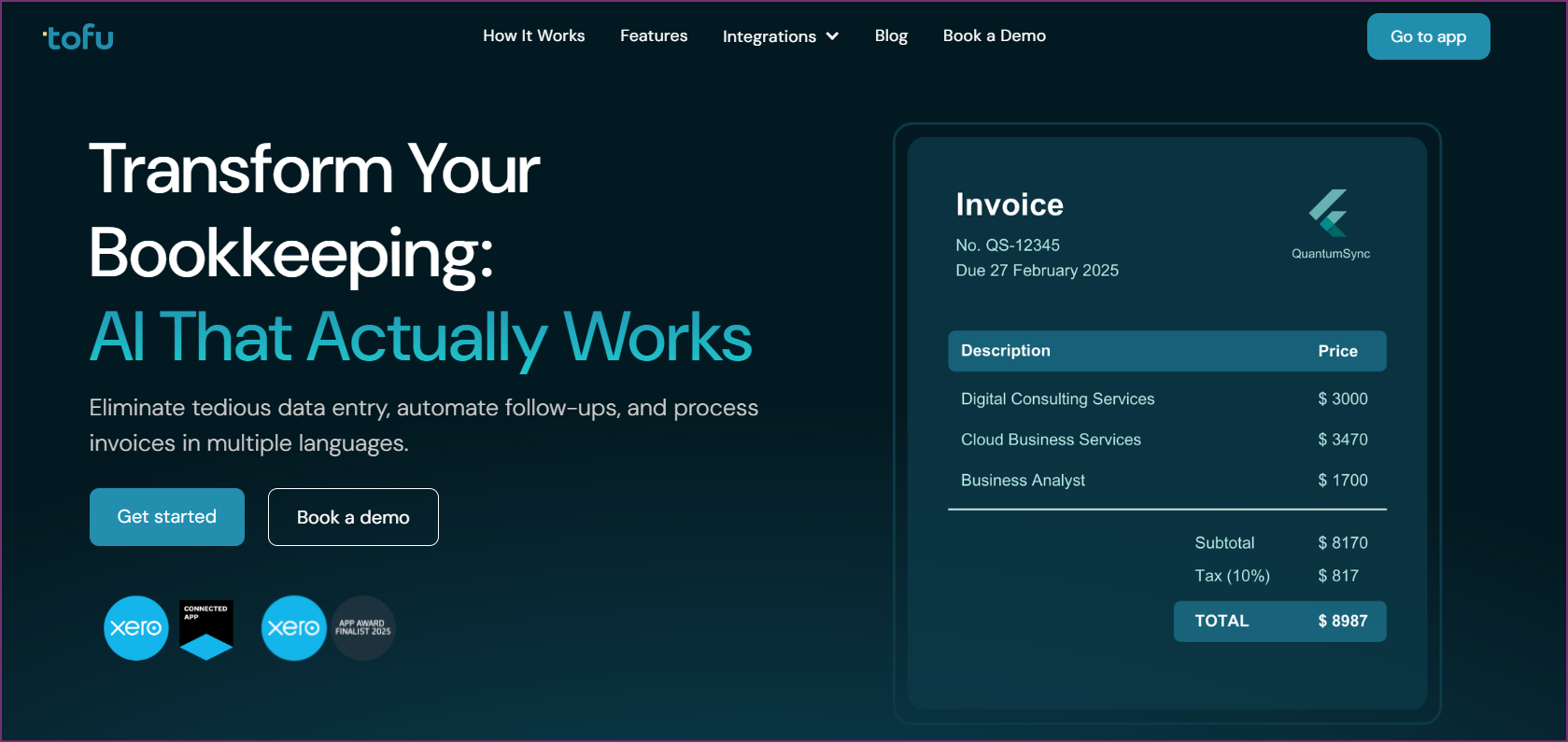
The fundamental difference between Tofu and every other tool on this list is architectural. Where competitors use rules, templates, and language packs, Tofu uses AI that understands document context in any language without requiring any configuration.
Upload a fapiao from a Shenzhen supplier, a handwritten receipt from a Bangkok market vendor, and an Arabic invoice from a Dubai distributor - Tofu processes all three correctly, without any pre-setup for any of these document types.
Traditional OCR tools for accounting require rule configuration: you tell the software where to find the date, vendor name, amounts, and line items on a specific supplier's invoice. When you add suppliers from new regions writing in different scripts, you need to create new rules. When suppliers change their invoice design, rules break.
Tofu's AI infers document structure from context. It recognizes that a column of numbers with a currency symbol following them is likely pricing, regardless of whether the surrounding text is in Chinese, Arabic, or Portuguese. This inference-based approach means:
Tofu processes 200+ languages, with particular strength in APAC scripts that matter for international accounting:
The zero-configuration approach means language processing is not a separate module to activate - it handles whatever script appears in the document automatically.
Many OCR tools for accounting extract only totals: the final invoice amount and perhaps the tax figure. For a single-item receipt, this is adequate. For multi-line invoices with itemized goods, services, or materials, totals-only extraction forces manual re-entry of every line.
Tofu extracts complete line-item data: item description, quantity, unit price, line total, tax code, and any reference numbers. This matters for:
Accounting documents are rarely perfect. Tofu's AI handles:
Both plans use entity-based pricing - no per-user fees. Your entire team, including client-facing accountants and admin staff, can access the platform within a single subscription. This contrasts with per-user tools where adding team members drives costs up significantly.
Note: Tofu does not charge per document - pricing is fixed monthly, providing predictable costs as document volume grows.
Tofu integrates directly with:
Accounting firms serving APAC clients, businesses importing from China or other Asian markets, multi-national businesses with diverse supplier document types, and any firm that has given up on rule-based OCR due to configuration overhead.
Dext (formerly Receipt Bank) is the most widely used accounting document processing tool in English-speaking markets. Its long history and deep integrations with Xero, QuickBooks, and other platforms have made it the default choice for many accounting firms.
Dext's extraction relies on supplier rules. When a new supplier document arrives, Dext reads it and you can set rules for how future documents from that supplier should be extracted. For high-volume relationships with consistent suppliers, this works well.
For firms with diverse, international suppliers - particularly those sending documents in Asian or Arabic scripts - the rule-based approach becomes a limitation. Dext's language support is weighted toward Latin scripts, and complex scripts require additional configuration or manual handling.
Dext's Business plan starts at $31.50/month for 5 users with 250 documents included. Annual subscriptions reduce this to approximately $25.21/month. Adding users costs extra and includes additional document allowances.
This document-included pricing model means firms processing high volumes need to monitor usage carefully to avoid overage charges.
UK, US, Australian, and New Zealand accounting firms processing primarily English-language documents with established supplier relationships where the setup overhead is a one-time investment.
AutoEntry is a receipt and invoice capture tool that uses a credit-based pricing model, making it accessible for businesses with lower document volumes. Acquired by Sage in 2019, it maintains good integrations with Sage software as well as Xero and QuickBooks.
Credits apply to different document types at different rates (bank statements cost more credits per page than receipts).
AutoEntry handles English-language documents reliably. For Asian languages or Arabic, accuracy drops and manual intervention is often required. This is a significant limitation for businesses with international supplier relationships.
Small businesses with English-language suppliers processing fewer than 100-200 documents per month who need a basic automation layer above manual entry.
Datamolino is a document processing tool with strong accuracy ratings and a document-volume pricing model that suits smaller European accounting firms. It handles European languages reliably and provides good line-item extraction for invoices.
Datamolino handles English, German, French, Spanish, Italian, Czech, Slovak, and other European languages well. Asian scripts and Arabic are not supported. This positions Datamolino firmly as a European-market tool.
Small UK, European, or Irish accounting firms processing primarily English and European-language documents with known monthly volumes.
HubDoc is included free with all Xero subscriptions, making it the default starting point for Xero-based accounting firms wanting automated document collection. It excels at fetching statements and invoices directly from supplier portals rather than scanning physical documents.
HubDoc's extraction captures total amounts from documents - it does not extract line items. For simple expense receipts where only the total matters, this is sufficient. For inventory-tracked businesses or those needing per-line tax calculation, totals-only is inadequate.
HubDoc was built primarily for English-language markets. Its supplier fetch capabilities work with suppliers that have English-language portals. For multi-language document processing, HubDoc is not the right tool.
HubDoc is free with all Xero subscription plans. There is no standalone paid tier.
Xero users who primarily receive supplier documents digitally via portal fetch or email, and whose suppliers use English-language invoices with no line-item extraction requirement.
Lightyear positions itself as a full accounts payable automation tool rather than just OCR. It combines document capture with approval workflows, purchase order matching, and supplier management - making it more comprehensive than pure OCR tools but more expensive.
Lightyear's strength is in AP workflow automation for English-language businesses. Its OCR extraction is focused on English and Western European documents. For businesses with Chinese, Arabic, or other Asian supplier documents, Lightyear is not designed for this use case.
Mid-size English-language businesses that need full AP automation - not just document capture, but purchase orders, multi-level approvals, and supplier payment management.
ABBYY FineReader is a general-purpose OCR tool that is not specific to accounting. It handles 190+ languages with strong accuracy for document conversion, making it relevant here for businesses needing multi-language extraction that they then process manually or via custom integrations.
ABBYY FineReader PDF Standard starts at $199/year. Higher-tier plans with network deployment and additional features are available at higher pricing.
ABBYY FineReader is powerful for document conversion but is not designed for accounting workflows. It lacks:
It is relevant for businesses with specific technical requirements and custom development capacity to build their own extraction pipelines.
Technically sophisticated businesses building custom document processing pipelines who need a broad-language OCR engine as a component. Not suitable as a plug-and-play accounting OCR tool.
The accounting software market has recognized that language diversity is not an edge case for firms operating in global markets - it is the norm. Suppliers in China, Southeast Asia, the Middle East, and South Asia now represent significant portions of supply chains for businesses worldwide.
Traditional OCR tools built for Western markets are adding language modules in response, but adding a "Chinese support" module to an English-language tool is architecturally different from building multi-language support from the ground up. Tools like Tofu that were designed for language diversity from the start have a structural advantage over retrofitted competitors.
The shift toward AI-based extraction (understanding document context rather than matching templates) is accelerating across the category. Firms still investing in rule-based OCR maintenance are increasingly questioning whether the configuration overhead is worth it when zero-configuration alternatives are available at comparable pricing.
Tofu is the best option for Chinese fapiao processing in accounting contexts. It handles Chinese Simplified and Traditional natively without configuration, extracting line-by-line data from fapiao and pushing it directly to Xero or QuickBooks Online. No other accounting-specific OCR tool on this list handles Chinese fapiao reliably without manual intervention.
Most OCR tools struggle with handwritten documents regardless of language. Tofu handles handwritten documents using AI that interprets context rather than relying on clean printed character recognition. ABBYY FineReader also has some handwritten text support but requires more manual review.
Standard OCR tools recognize Latin-script characters (English, French, German, etc.) reliably. Multi-language OCR extends recognition to non-Latin scripts: Chinese, Arabic, Japanese, Korean, Thai, and dozens of other writing systems. For accounting use specifically, multi-language OCR needs to also understand document structure in those languages - not just recognize the characters but understand that certain patterns represent price columns, date fields, or vendor names.
HubDoc is free with Xero but handles English-only and captures only totals. There is no free multi-language OCR tool that provides accounting-ready line-item extraction across Asian and Arabic scripts. The technical complexity of true multi-language AI extraction means solutions in this space are paid services.
Accuracy varies by tool and language. Tofu's zero-configuration AI approach provides consistent accuracy across all 200+ supported languages because it reasons about document structure rather than matching patterns. Traditional rule-based tools achieve high accuracy for configured suppliers but drop significantly for new or changed document formats.
Tofu, Dext, AutoEntry, Datamolino, HubDoc, and Lightyear all integrate with Xero. Of these, only Tofu provides true multi-language (200+) processing. HubDoc is included free with Xero. For multi-language needs specifically, Tofu is the clear choice among Xero-integrated options.
Without OCR, multi-language invoices require manual data entry - someone reads the invoice (or translates it) and types the information into the accounting system. This is time-consuming, error-prone, and unsustainable at any significant volume. OCR automation, particularly zero-configuration AI like Tofu's, is the practical alternative.
Multi-language receipt OCR for accounting is a solved problem in 2026 - but only if you choose the right tool. The majority of the market still caters primarily to English-language Western businesses, leaving genuine gaps for APAC-focused and internationally-active firms.
For businesses that need reliable Chinese fapiao processing, Arabic invoice extraction, or mixed-language document handling alongside standard English receipts, Tofu is the clear front-runner. Its zero-configuration AI, 200+ language support, line-by-line extraction, and direct Xero/QBO integration make it purpose-built for the document diversity that modern accounting actually involves.
For English-market firms with simpler needs, Dext or AutoEntry handle high volumes reliably. For Xero users wanting a free starting point, HubDoc covers basic English document collection. For European firms, Datamolino's accuracy and pricing model is appealing.
The decision comes down to the languages in your document mix. If it's English and European languages only, several options work well. If it includes Asian or Arabic scripts, Tofu is the only purpose-built accounting OCR tool that handles these without configuration overhead.
Book a Demo with Tofu to see multi-language OCR processing for your specific document types.